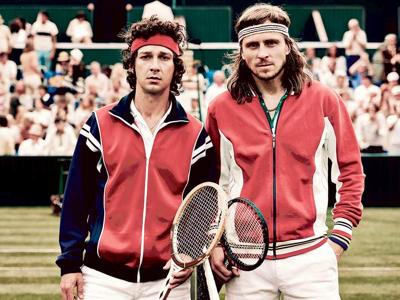
If you don’t already know who won the men’s singles tennis championship at Wimbledon in 1980, then for the sake of your own entertainment, try not to find out before you see Borg vs McEnroe, which is absolutely worth your time even if you don’t give a fig about tennis.
I couldn’t care less about the sport, and I nevertheless found this depiction of that Wimbledon final match – considered by some to be the finest tennis game ever – to be tense and gripping.
With “tension like torture,” as one match announcer describes it, and characterized by a brutality that “if this were a boxing match they’d stop the fight,” it’s one of the most excruciatingly suspenseful and unexpectedly moving bits of sportsball I’ve seen onscreen.
This is partly down to the uncommonly elegant skill that Danish director Janus Metz brings to this, his first narrative feature: He makes the game comprehensible even to those not in the know about the arcana of the rules and the oddities of the scoring. And first-timer Ronnie Sandahl’s script ensures that we understand what is at stake for each man beyond the obvious ambition to win.
But mostly it’s because, just as no sports movie is ever really about the sport itself, Borg vs McEnroe is not about tennis: It’s about men and their rage, and the very different ways that two very different men cope – or don’t – with it. (Barring the rare movie about women athletes, most movies about sports end up being about men and the emotions with which they are unable to cope except through pseudo-violent physical activity.)
In the summer of 1980, Björn Borg (Sverrir Gudnason), rockstar of tennis – almost literally, with how he is chased around the streets by fangirls – is after his fifth (consecutive!) Wimbledon title. John McEnroe (Shia LaBeouf), an up-and-comer notorious for his on-court outbursts, is after his first.
The players have met on the court before, but this moment is perhaps the culmination of their rivalry, and their rivalry that is amusing to the media in part because their on-court personalities are so different.
One Wimbledon commentator here dubs the almost robotically unemotional Swede “Ice Borg,” while the tantrum-throwing American – who screams at refs over what he deems bad calls, among other indecorous behaviors – is “Super Brat.”
Their playing styles are at odds, too: the powerful Borg is a “sledgehammer,” the precise McEnroe a “stiletto.”
As the two players work their way through the preliminary Wimbledon rounds and defeat the other entrants, the film flashes back to both Borg’s and McEnroe’s childhoods and the paths that led them to this showdown.
It’s not unexpected that this Swedish/Danish/Finnish co-production – though there is lots of English-language dialogue – focuses more on the Swede than the American, though that’s where we find the surprising bit of the story.
Astonishingly, the young Borg (played by the real Borg’s own son, Leo, as a tween, and as an older teen by Marcus Mossberg) is much like the adult McEnroe, a player who struggles mightily with his own anger in the game, cursing refs and throwing tantrums just as McEnroe is still doing, until he learns to control his emotions with the help of his coach (Stellan Skarsgård).
Borg has figured out how to sublimate his rage into winning – at least partly by concentrating on some very OCD-ish rituals to prepare for a match – in a way that McEnroe has been unable to do. That adds an intriguing layer to the public dynamic between the two players.
The fans, the commentators, McEnroe himself: they have no idea that Borg is just like his rival.
We see McEnroe attempting to reign himself in, and mostly failing, and we get hints about the tough childhood that may have helped shape his adult volatility. (Jackson Gann plays the young McEnroe.)
Of course Borg vs McEnroe is as much about two arrogant, difficult men competing against themselves as much as they are competing against each other. (That’s also a feature of most sports movies, isn’t it? Your real competition is always yourself.)
But one the most incisive aspects of the film is the unspoken commentary not merely on men and their emotions but on the toxicity of some expression, and some dampening, of them. Borg may come across as cool and calm, and McEnroe may come across as unhinged, but who is really healthier here? Is bottling up rage better or worse than expressing it, even if it’s ugly? Wouldn’t it be better to never let such feelings control you in the first place?
Either way, they’re both primed for a much-watched game.
Borg vs McEnroe ( * * * 1/2) • Directed by Janus Metz • Starring Sverrir Gudnason, Shia LaBeouf, Stellan Skarsgård • Rated R • 107 min. • At Osio Theater.
(0) comments
Welcome to the discussion.
Log In
Keep it Clean. Please avoid obscene, vulgar, lewd, racist or sexually-oriented language.
PLEASE TURN OFF YOUR CAPS LOCK.
Don't Threaten. Threats of harming another person will not be tolerated.
Be Truthful. Don't knowingly lie about anyone or anything.
Be Nice. No racism, sexism or any sort of -ism that is degrading to another person.
Be Proactive. Use the 'Report' link on each comment to let us know of abusive posts.
Share with Us. We'd love to hear eyewitness accounts, the history behind an article.