A gaily painted kite bucks and twists in the wind, tail snapping loudly as it soars, seemingly fragile, but jerking hard against the string held taught by an elderly man below. Joseph Yang and his adult daughter, Belle, are small figures gazing intently skyward, standing silent and apart on this Carmel beach.
So begins My Name is Belle, a documentary that airs on KQED on May 20 and on many public broadcasting stations thereafter. It is the most recent production of Terri DeBono and Steve Rosen of Monterey, who have been making documentary and short dramatic films together for almost 20 years.
Belle tells the story of Pacific Grove artist and author Belle Yang through a mosaic of voices and images in a filmmaking style that is very much the signature of the duo, who, as Mac and Ava Motion Picture Productions, have garnered numerous awards for documentaries, including Accidental Hero and Beyond Barbed Wire.
“We build the story out of interviews,” Rosen says. “Each film is a patchwork of elements in a narrative style appropriate to the subject.” Belle’s characters are introduced on that beach as the camera focuses and fades from the transparent pattern of the bouncing kite to close-ups of the faces tilted skyward. Meanwhile, the voice of Santa Cruz writer, photographer and philanthropist George Ow speaks of the fate of immigrants, each new wave taking jobs that nobody wants, struggling with language and prejudice and fear, until the next wave replaces them on the lowest rung of the social ladder. “I want to keep my children and grandchildren aware of the immigrant experience,” he says. “People should know where they come from; it makes them more compassionate.”
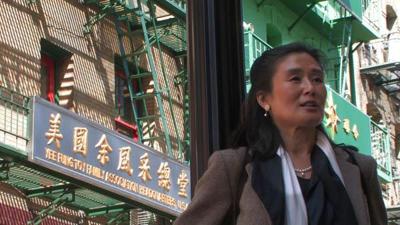
In a picture book called Hannah Is My Name, Belle Yang tells the story of the immigrant experience seen through the eyes of a child. It’s the Yang family story. As she tells how the book came to be written, we see her walking through Chinatown, where her family arrived without green cards some 45 years ago. Her father, at age 17, had walked barefoot and alone across the expanse of China to Taiwan after the violent Communist takeover of the Yang ancestral home in Manchuria.
We see Belle reading the story to children, and then the camera closes in on the colorful pages. The paintings are lively and bright, using vivid areas of flat color with vigorous brush drawing on top. As Belle reads the words, the camera pans across the paintings, bringing the still pictures to life by moving through them in the direction of the story. Several times, so subtly that it isn’t surprising, pictures are animated to further the narrative.
~ ~ ~
“A lot of the visual style that I liked early on came from Ingmar Bergman in the ‘60s,” says Rosen, “making faces the story, using tight close-ups shot in natural light to get a sense of people in their environment, in a place where they belong.”
Joseph Yang talks about his daughter’s work as he sits at a table by window-light. He wields a sumi-e brush confidently, inking a long paper scroll. Belle had not been interested in her Chinese heritage, we learn from her father… and feel his disapproval.
“We had no natural understanding,” Belle says of herself and her father. “His spiritual address was in the East, mine so much in the West.” It wasn’t until she went to China to study that she learned to love not only its formal painting style, but also its childlike folk art.
By that time the Yang family had moved far from their early flophouse address in San Francisco to manage a store in Carmel. By the time Belle was 11, Joseph Yang had established the Peking Gift Shop there; he ran it for 17 years, often selling his own paintings and calligraphy in the formal style.
Belle Yang’s books tell the stories of her family: Hanna Is My Name about the immigrant experience from her childhood perspective, Baba: A Return to China Upon My Father’s Shoulders spins Chinese folk tales as told by her father, and The Odyssey of a Manchurian, the story of her father’s barefoot journey across China from Manchuria to Taiwan. “Always art and words together,” Belle says. “The Chinese scholar painters wrote poems to go with their art work. The Chinese characters themselves were originally pictures. The language cannot do without pictures, so it is very natural for me to work this way.”
Terri DeBono is Mac and Eva’s writer and producer, and has been making films here with Rosen for 20 years. “We refused to go to LA, where getting films produced would be simpler, but we wouldn’t have the freedom we have here,” she says. “It’s just taken us longer to prove ourselves.” The long list of their awards and upcoming productions indicates that they have succeeded.
Belle closes as the artist-author finishes reading her book to the children and thanks her father: “I thought you had come to this country with empty pockets,” she says, “but they were jingling with stories, my inheritance.”
MY NAME IS BELLE
premieres on KQED Channel 9 at 5pm, May 20, and at 2:30pm, May 27, on KTEH/KCAH Channel 10. For a complete list of showtimes, visit kqed.org.
(0) comments
Welcome to the discussion.
Log In
Keep it Clean. Please avoid obscene, vulgar, lewd, racist or sexually-oriented language.
PLEASE TURN OFF YOUR CAPS LOCK.
Don't Threaten. Threats of harming another person will not be tolerated.
Be Truthful. Don't knowingly lie about anyone or anything.
Be Nice. No racism, sexism or any sort of -ism that is degrading to another person.
Be Proactive. Use the 'Report' link on each comment to let us know of abusive posts.
Share with Us. We'd love to hear eyewitness accounts, the history behind an article.