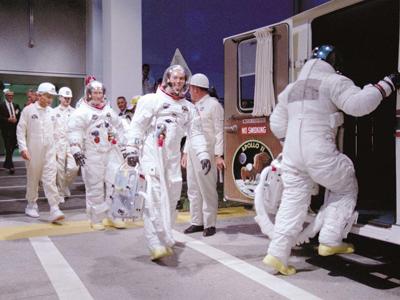
It will be 50 years ago this summer that Americans first walked on the moon.
Although the event has been a subject dear to filmmakers since Georges Méliès made A Trip to the Moon in 1902, it’s safe to say that audiences haven’t seen a film like Apollo 11 until now. This feature-length documentary takes us inside the event with footage that’s never before been seen or heard. It’s a celebratory movie designed to rekindle awe and admiration for the accomplishments of the NASA astronauts and ground scientists, as well as a reminder of the endless realms of possibility that can be achievable when a country and its politicians work in unison toward a shared goal.
Director Todd Douglas Miller (Dinosaur 13) assembled Apollo 11 from a trove of newly discovered 65mm footage and 11,000 hours of uncatalogued audio recordings. Painstakingly, the audio was matched up with the soundless footage of the scientists monitoring their computer stations in the Mission Control Center. This adds to the sense of the accomplishment being the result of a whole community’s efforts rather than the just the heroic actions of three brave astronauts: Neil Armstrong, Buzz Aldrin and Michael Collins.
NASA cinematographers filmed everything, not only the Mission Control scientists (all men, most of whom wear short-sleeved, white, button-down shirts and ties appropriate for Houston in mid-July), but also the mechanical workers prepping things on the launchpad platforms and catwalks.
Also filmed were the crowds that assembled on the nearby beaches and parking lots, providing not only a sense of late-’60s style and fashion but also the feeling of a populace unified in fear and pride around this one event – even though once in a while on a radio or TV we hear progress reports from the Vietnam battlefield, as well as news of Ted Kennedy’s contemporaneous crash at Chappaquiddick.
Apollo 11 is free of extraneous narration, which helps lend it a present-tense feel. We hear snatches of John F. Kennedy’s 1961 inaugural speech, which issued the challenge to land on the moon before the end of the decade, as well as avuncular Walter Cronkite setting up the mission’s objectives.
The movie doesn’t tell you anything you didn’t already know about the moon landing, but it doesn’t need to. Even without the narrative of a landing craft running short on fuel, the touchdown is still both harrowing and thrilling. The film takes you back to the moment in history when it happened, and makes you feel like you’re there watching it unfold in real time.
With that comes a certain expectation for feeling a sense of pure awe – something that’s especially nice in this era of pervasive cynicism. There is a team as well as a nation locked into a common goal. Imagine.
The sound is not perfect. The electronic music by Matt Morton can be overwhelming at times in its attempt to heighten tension. Also, the restored communications between land and sky, despite their historic value, can resemble the scratchy sound of sitting too long at a drive-through squawkbox.
No mention is made in the film of the U.S./Russian space race that drove the less lofty goals of the mission. Instead, Apollo 11 leaves us to ponder those words left behind on the moon with the American flag: “We came in peace for all mankind.”
Come to think of it, that’s not such a bad reminder as we face the imminent possibility of a military-based Space Force.
APOLLO 11 ( 3 ) • Directed by Todd Douglas Miller • Starring Buzz Aldrin, Joan Ann Archer, Janet Armstrong • Rated G • 93 min. • At Osio Theater
(0) comments
Welcome to the discussion.
Log In
Keep it Clean. Please avoid obscene, vulgar, lewd, racist or sexually-oriented language.
PLEASE TURN OFF YOUR CAPS LOCK.
Don't Threaten. Threats of harming another person will not be tolerated.
Be Truthful. Don't knowingly lie about anyone or anything.
Be Nice. No racism, sexism or any sort of -ism that is degrading to another person.
Be Proactive. Use the 'Report' link on each comment to let us know of abusive posts.
Share with Us. We'd love to hear eyewitness accounts, the history behind an article.