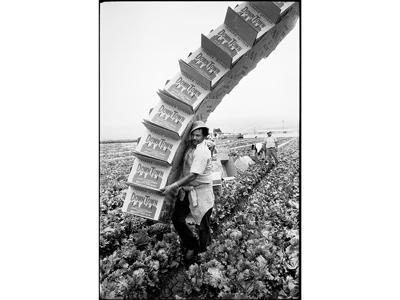
This piece was originally published by the Weekly on May 26, 2016 as part of a cover story.
For almost 40 years, the images stayed out of sight, frozen on negatives.
They were shot in the Salinas Valley during the summer of 1975 by Mimi Plumb, who was then an undergraduate photography student at the San Francisco Art Institute.
They were again brought to light in 2014, when Plumb – a recently retired photography teacher at San Jose State University – became enthralled in Miriam Pawel’s newly published biography of Cesar Chavez, The Crusades of Cesar Chavez.
“It just brought it all back for me in a powerful way,” Plumb says.
Plumb thought Pawel might want to see the pictures she had taken in ’75, so she got into touch, and indeed, she was right.
“I had never seen [photos] like these,” Pawel says. “I’d never seen another photo of an election in the fields.”
The pictures capture an optimistic, historic moment in the farmworker rights movement, just months after Gov. Jerry Brown, then in his first term, signed a law allowing farmworkers to petition for secret-ballot elections and to join the union of their choice. Those rights were unprecedented in the nation.
After Pawel saw some of the pictures, she and Plumb decided to embark on a collaborative project, which culminated with the April 3 launch of “Democracy In The Fields,” a website – demointhefields.com – that tells the story of that summer through prose, research and above all, imagery.
Plumb’s photos are stunning, and filled with humanity. That’s in part because she wasn’t approaching the subject as a photojournalist – she was schooled in fine art photography, and more interested in people than events. Her artistry is not focused on raised fists, but in the creases on farmworkers’ faces, and in the brimming spirits of the newly empowered.
Nonetheless, Plumb had just missed the ’60s, and knew she was seeing something historic.
“I was really moved by people feeling they could change their lives,” she says. “I wanted to be a part of that.”
Plumb fell into the project by chance: In 1974, her brother Tom invited her on a visit to La Paz, the United Farm Workers headquarters outside of Bakersfield where his girlfriend (and now wife) was working. Plumb had no interest in working for the UFW, but began helping out in its darkroom, and over time, she established the contacts that ultimately led her to Salinas a year later, where she would document history being made.
Several of the photos in Democracy in the Fields follow part of the march Cesar Chavez led, beginning in July 1, 1975, through the heart of California farmland. That march swelled when it reached the Salinas Valley, and Plumb’s photos track it from San Miguel to Salinas. She also captures the elections that followed. The first was held in a Castroville artichoke field.
Pawel, a biographer and formerly a reporter with the Los Angeles Times, has crafted a compelling narrative to accompany the photos, which gives a concise, historical context to the images. Having researched Chavez for nearly a decade, her authoritative familiarity with the material is immediately apparent, and is in fact what inspired the project.
“I actually recognized people in the photos,” she says.
Plumb had few notes from that summer, so she and Pawel got together to try and re-create the moments, and through research and interviews, tell the story behind the images.
“She was interested in photographing farmworkers more than leadership,” Pawel says. “She photographed the movement in a way no one else did, and at a really pivotal moment in time.”
The idea behind Democracy in the Fields, Pawel says, is to share that moment, and its people, with the world.
“The ability of people who had seen themselves as powerless, who were among the poorest workers in the country, for them to come together against these enormous odds shows the power of organizing,” she says. “That to me is the most important takeaway, and one that is extremely relevant today.”
(0) comments
Welcome to the discussion.
Log In
Keep it Clean. Please avoid obscene, vulgar, lewd, racist or sexually-oriented language.
PLEASE TURN OFF YOUR CAPS LOCK.
Don't Threaten. Threats of harming another person will not be tolerated.
Be Truthful. Don't knowingly lie about anyone or anything.
Be Nice. No racism, sexism or any sort of -ism that is degrading to another person.
Be Proactive. Use the 'Report' link on each comment to let us know of abusive posts.
Share with Us. We'd love to hear eyewitness accounts, the history behind an article.