Excerpted from an article that was originally published in the Weekly on June 17, 2016.
In Monterey County, when bells chime through a neighborhood, it’s often a sign that something sweet is coming.
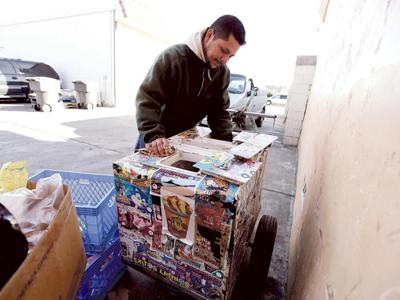
Ice cream trucks have their trademark track – a jingle that echoes from the truck’s speaker system on summer afternoons – drawing people in for push-pops and Klondike bars. But in Latino neighborhoods, the prefered ice cream comes from a paleta (or popsicle) cart.
The people who push those carts – the paleteros – roll and ding through residential areas, parks and schools selling paletas that are either water – or milk-based and chock-full of chunks of fresh fruit.
The treats come in an array of colors and flavors ranging from spicy lime-chile to savory rompope (eggnog).
Often the chimes in Seaside emanate from bells attached to the cart of 38-year-old Alberto Reyes, who has been roaming the area for about eight years.
At the end of a breezy day in December, Reyes walks uphill with his cart and cardboard box of churritos – orange-colored fried flour chips that look like little wheels – stacked on top of it. He says that although most of his customers are children, he gets to know most people in the neighborhood.
“You spend time with the kids, get to know the people in the neighborhood, some get angry at me because they don’t want to spend money, and then sometimes you encounter racist people who don’t want you in the country,” Reyes says in Spanish.
“But overall,” he says, “it’s safe.”
Reyes used to work in Salinas, where business is better because of the larger Latino population, but he got robbed once. That made him warier about where to keep his money and led him to Seaside.
“It’s much safer here,” he says. “The cops patrol a lot more.”
In Salinas, Jose “El Chilango” Aguillon, who has been a paletero for nine years, says getting robbed is a risk that comes with the job.
“It doesn’t matter if it is dark or not, they can find you and take your money if they want to,” Aguillon says in Spanish. “I just give the money to them. Better to do that than for the situation to get more violent.”
Aguillon has two kids, ages 13 and 15. He says his kids worry about him roaming Salinas.
“Every night when I come home they go: “Dad, dad, are you OK?” and “Are you going back out tomorrow?” I tell them not to worry, that their dad is a ‘chingon,’” he says, invoking the Spanish equivalent of tough mofo. “It’s all I can do. I need to provide for them.”
Aguillon says he makes an average of $40 per day in Salinas. Reyes says he earns about the same amount, but for him, being a paletero is a side job. He says that, at the most, he will sell about 100 paletas during a five-hour shift, which would leave him about $50.
With the menace of muggings lingering and the low-profit margin, the job proves more demanding than many members of the community realize.
“We don’t make much, but it is enough for what we need,” Aguillon says. “That’s why I keep doing it. It’s a humble job that keeps me grounded.”
(0) comments
Welcome to the discussion.
Log In
Keep it Clean. Please avoid obscene, vulgar, lewd, racist or sexually-oriented language.
PLEASE TURN OFF YOUR CAPS LOCK.
Don't Threaten. Threats of harming another person will not be tolerated.
Be Truthful. Don't knowingly lie about anyone or anything.
Be Nice. No racism, sexism or any sort of -ism that is degrading to another person.
Be Proactive. Use the 'Report' link on each comment to let us know of abusive posts.
Share with Us. We'd love to hear eyewitness accounts, the history behind an article.