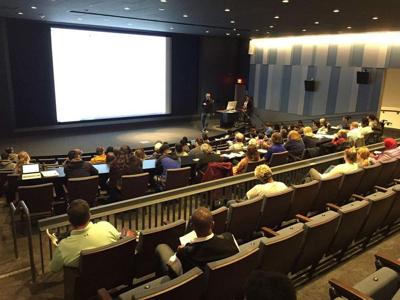

Kevin Willmott was in town to celebrate Black History Month at CSU Monterey Bay, and his visit concluded with a masterclass in screenwriting on Monday, Feb. 17, 2020 at the university’s College of Arts, Humanities and Social Sciences. (Willmott is also a professor of film at the University of Kansas.) It was attended by many students from CSUMB’s Cinematic Arts and Technology Department, as well as community members who might be pursuing cinematic aspirations. Below is some of Willmott’s advice on successful screenwriting.
“It all starts with the screenplay. It’s hard to make a good film without it. [The screenplay] is the blueprint.”
“How do you become a director or a screenwriter? You gotta do it. You gotta write all the time.”
“You’ve got to know that what you’re doing is worthy. You’ve got to be willing to listen to others, to take criticism.”
“If you don’t have a good script, no one’s going to want to work with you. If you have a great script, people will work for you for free. Take as much time as you can to get the script ready to go. It’s hard to know if it’s ready. That comes with skill, from doing it. Have a community of writers around you to take a look at [your] script.”
“William Goldman said, ‘No one in Hollywood knows anything.’ I showed my film to an agent. He said, ‘Kevin, what do you want me to do with this?’ The next day it got accepted to Sundance. ‘Kevin, you’re a genius.’”
“A screenplay has a three-act structure. The first act is set-up, the first 30 pages or so, everything we need to know. Page 10 is the inciting incident. A page of screenplay is a minute of movie. Buy Final Draft [scriptwriting software], it’s industry standard. $100. The inciting incident is the hook. It holds you. James Bond movies start with a big fight, a car chase. What are you going to learn about James Bond in the first 10 minutes? He’s a handsome guy, a slick dude, women love him. He’s a badass. He’s got resources, gadgets. In the first 10 minutes you’ll know James Bond through the action of the movie.”
“What’s the best way to get character across? Through action and conflict.”
“You have to play fair with the audience. Or they’ll walk out.”
“The first act is setting up the rules of the world. You’ve got to know your world. Movies are about taking us someplace we haven’t seen. Or what new thing can you bring? What’s the genre or subgenre? You need to know as much about it as you can. You need to be expert. Movie history is really important, the kind of movies [yours is] like, what’s worked, what’s failed.”
“Page 25, 27, 30, is the first plot point. A big reversal. Like in a Dirty Harry movie. Clint Eastwood lives around here, doesn’t he? Dirty Harry lives right down the street. We’re investigating a crime, we think we know who the criminal is, then a big reversal – the opposite of what’s going on. The partner gets killed or something dramatic happens. We go from this direction to a new direction. Plot points are tricky because they had to come organically. Not out of the blue.”
“The second act is the confrontation. It’s the hard part of screenwriting. You have to have a really good plot point, invest in the situation with inciting incidents, then a catapult to the plot point. Characters run out of stuff to do. Amistad is a great example, a movie where Morgan Freeman’s standing around like ‘Somebody call my name?’ He doesn’t have a lot to do. That’s a problem.”
“Who’s going to be the hero? Is your movie going to be a single hero? Or two people that goes back and forth? Or a Robert Altman film, six or seven people exploring a common idea? You need to figure that out now. The point is to keep you from doing a lot of work that goes nowhere.”
“The second act is about 60 pages. There’s a midpoint at page 60. I look at them as energy drinks, as an oasis. When you first start writing, you just have to get to page 25. That oasis will give you a lot to do, then you just have to get to 30 more pages to the midpoint. It’s hard to figure out. It links the first half to the second half.”
“A good midpoint is ET: The Extra-terrestrial. ‘ET go home.’ Declare what the character wants.”
(0) comments
Welcome to the discussion.
Log In
Keep it Clean. Please avoid obscene, vulgar, lewd, racist or sexually-oriented language.
PLEASE TURN OFF YOUR CAPS LOCK.
Don't Threaten. Threats of harming another person will not be tolerated.
Be Truthful. Don't knowingly lie about anyone or anything.
Be Nice. No racism, sexism or any sort of -ism that is degrading to another person.
Be Proactive. Use the 'Report' link on each comment to let us know of abusive posts.
Share with Us. We'd love to hear eyewitness accounts, the history behind an article.