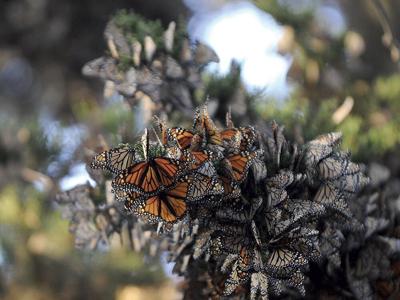

Excerpted from an article originally published in the Weekly on Dec. 5, 2019. This week, the U.S. Fish and Wildlife Service is expected to announce whether monarchs should be listed as an endangered species. The results of the 2020 Thanksgiving week count was under 1,800 butterflies.
Jeanette Kihs, executive director of the Pacific Grove Museum of Natural History, states plainly what others in Pacific Grove keep echoing.
“Everyone wants what’s best for the monarchs. No one wants to see less monarchs in Pacific Grove than in the past,” she says. “There’s not necessarily agreement on how to bring more monarchs back here.”
Pacific Grove Mayor Bill Peake asked Kihs and the current Beautification and Natural Resources Commission chair, Jean Anton, to include a monthly report by a museum docent at commission meetings to improve communication. His solution for the future of the sanctuary is providing “a respectful venue for a full range of public comment.” He expects a report about the sanctuary to come to council in January.
Barbara Thomas, a former member of the Beautification and Natural Resources Commission, says more voices and plans aren’t going to bring the monarchs back.
“This is just one big tragedy,” Thomas says. “Every year there’s an excuse why something happened or why it didn’t. And this year’s excuse: ‘It’s all over the state, they’ve disappeared.’ Once again it’s no one’s fault. It’s everyone’s fault, if you ask me.”
At 87, Frances Grate, also formerly of the BNR, hasn’t given up hope for the sanctuary or the monarchs. Last month she and local activist Robert Pacelli met with a public works employee and the city’s volunteer coordinator about making sure the nectar beds are well tended. She sees it as a sign that the city will exert more authority over the sanctuary and coordinate efforts.
While some still hold out hope that the monarchs will continue their annual sojourn to P.G., others find themselves more pessimistic about the future. The monarch numbers within the sanctuary are disturbingly low this year, while other California sites are doing better. On Nov. 21, the Western Monarch Count Resource Center reported that Lighthouse Field in Santa Cruz was reporting 3,402 monarchs, compared to 1,802 documented in 2018 during the annual Thanksgiving Count.
On Nov. 29, the museum’s docents performed the annual count inside the sanctuary, used by the Xerces Society as the official record of the health of each year’s migrating monarch population.
The week before, the count was 642, on that Friday, only 179 monarchs were counted inside the sanctuary. The weather was bad that week, and it’s possible the monarchs sought refuge elsewhere during the cold storms.
That nearly 500 butterflies disappeared in the bad weather is exactly the problem at the sanctuary, says Grate. There aren’t enough trees to give the butterflies a safe place to cluster together against the wind and the cold.
“It will be sad, very sad, with all the good effort that has been put into it to have the butterflies not come again,” Grate says.
(0) comments
Welcome to the discussion.
Log In
Keep it Clean. Please avoid obscene, vulgar, lewd, racist or sexually-oriented language.
PLEASE TURN OFF YOUR CAPS LOCK.
Don't Threaten. Threats of harming another person will not be tolerated.
Be Truthful. Don't knowingly lie about anyone or anything.
Be Nice. No racism, sexism or any sort of -ism that is degrading to another person.
Be Proactive. Use the 'Report' link on each comment to let us know of abusive posts.
Share with Us. We'd love to hear eyewitness accounts, the history behind an article.