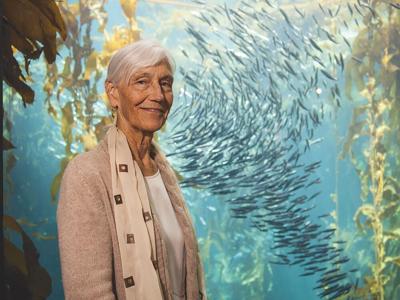

This story is excerpted from an article that was originally published in the Weekly on Nov. 7, 2019.
Weekly: You’re the first and only executive director of the Monterey Bay Aquarium. What did you think you’d be doing now, 35 years later, and does your job resemble that?
Packard: Definitely not. Am I pleased and grateful that I’ve had this opportunity? Absolutely. It’s been amazing.
I’ve always taken my career in an incremental fashion. My philosophy in life is, as long as you’re learning something every day and you’re working with great people and you’re motivated and you’re motivating them, it’s all good. The Aquarium just keeps growing and changing and there’s never a shortage of interesting things to be involved with. Being involved with the Monterey Bay Aquarium was an incredible opportunity and such a privilege.
The original Aquarium mission statement was: “The purpose of the Monterey Bay Aquarium is to stimulate interest, increase knowledge and promote stewardship of Monterey Bay and the world’s ocean environment through innovative exhibits, public education and scientific research.” In 1996, you changed it to, “The mission of the Monterey Bay Aquarium is to inspire conservation of the ocean.” Why?
Stepping up our focus on conservation included changing our mission statement. That was a big move, to redefine the public aquarium as a force for conservation impact.
It was in response to the growing human impact on the ocean, and the fact that there was an idea that the ocean is so vast that as a terrestrial species, we couldn’t affect it.
Has the Aquarium made a difference and how can you tell?
One of the impacts we’ve had is with Seafood Watch, plastic awareness, awareness about the ocean’s role in climate change, and that it plays such a big role in modulating climate change.
Perhaps the biggest impact we’ve had – which most of our local visitors might not see – is inspiring a lot of other institutions to take up the challenge of having conservation as their core mission. That’s really exciting to me.
The past few years, we have been working on the idea to launch a collaborative of the major public aquariums around the U.S. to do ocean policy and advocacy together. We’ve not only demonstrated that people trust us as an information source – important especially in today’s world, where people are just bombarded by information and they want to know what is happening in the environment and what they can do.
We inform and activate people around things they can get involved with. We’re taking that model national now with the Aquarium Conservation Partnership, 20 major aquariums with common ocean conservation agendas. Together we have at least 25 million visitors a year.
Given the worsening climate crisis in the last 35 years, it seems the urgency of your mission has also increased.
Environmental crises – most of all, climate change – have definitely escalated. Twenty-five years ago, ocean conservation wasn’t really on anyone’s screen. Even though we have protected the big charismatic wildlife [like whales and dolphins], we have ocean acidification, ocean warming, microplastic – there are myriad perturbations happening in the ocean.
Two things are happening: The scale of human impact has grown exponentially. And the more science we do, we have a much deeper understanding of the ocean.
On the subject of climate solutions, I wonder how you feel about investing in technology to sequester carbon. I hear the argument that by looking for a technological fix, it’s dodging the bigger challenge of forcing governments to commit to reducing emissions.
I think we have to do all of the above. I don’t personally agree that is admitting defeat. I think there are potential environmental concerns about some of the schemes. But there will be some technological developments, I’m sure.
(0) comments
Welcome to the discussion.
Log In
Keep it Clean. Please avoid obscene, vulgar, lewd, racist or sexually-oriented language.
PLEASE TURN OFF YOUR CAPS LOCK.
Don't Threaten. Threats of harming another person will not be tolerated.
Be Truthful. Don't knowingly lie about anyone or anything.
Be Nice. No racism, sexism or any sort of -ism that is degrading to another person.
Be Proactive. Use the 'Report' link on each comment to let us know of abusive posts.
Share with Us. We'd love to hear eyewitness accounts, the history behind an article.