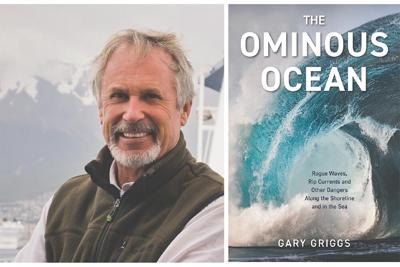

A lot of us think of the ocean as a pleasant place – something nice to look at, nice to wade in, maybe nice to recreate in, if you can tolerate cold temperatures in local waters. Gary Griggs, a geologist who teaches at UC Santa Cruz, likes the ocean, but he’s written a book about all the ways it can conspire to kill you. Released in June, The Ominous Ocean: Rogue Waves, Rip Currents and Other Dangers Along the Shoreline and in the Sea is an exploration of the many hazards of the sea, from tsunamis to stingrays, with detours into notorious places like the Bermuda Triangle.
That Griggs is drawn to worst-case scenarios maybe comes as no surprise to those familiar with his work; he’s also the author of Between Paradise and Peril: The Natural Disaster History of the Monterey Bay Region.
The intent of this recent book is to bring some perspective to people who like to play in the ocean but may have a disproportionate fear of things. It might be a counterintuitive approach to elucidate the bad stuff in order to calm people’s nerves, but if data helps you talk yourself out of unfounded fears, then it’s a useful read. For example, despite a shark biting a swimmer at Lovers Point on June 22, shark-human interactions remain rare – and something you shouldn’t be afraid of. (I try deploying this data to my brain while swimming in Monterey Bay, and it doesn’t always work; I might think about sharks for an entire mile-long swim.)
To make the point, Griggs compares shark bite fatalities – one death in Monterey Bay in 100 years – to drownings, with sometimes 10 in a stormy winter season with big waves.
Griggs recently got a call from a reporter asking to do an interview about a perceived “spike” in shark incidents in Monterey Bay. “I said, ‘frankly I don’t see any spike in attacks,’” Griggs says.
Despite dwelling on the worst, Griggs insists oceans are safe – and situational awareness can make them safer. That includes knowing how to recognize riptides, which are responsible for about 80 percent of lifeguard rescues a year.
“Your odds of drowning at the beach are very low, but being in the wrong place at the wrong time, not being aware of your surroundings or being overly confident in your swimming ability are all recipes for potential disaster during an otherwise nice day at the beach,” Griggs writes.
(0) comments
Welcome to the discussion.
Log In
Keep it Clean. Please avoid obscene, vulgar, lewd, racist or sexually-oriented language.
PLEASE TURN OFF YOUR CAPS LOCK.
Don't Threaten. Threats of harming another person will not be tolerated.
Be Truthful. Don't knowingly lie about anyone or anything.
Be Nice. No racism, sexism or any sort of -ism that is degrading to another person.
Be Proactive. Use the 'Report' link on each comment to let us know of abusive posts.
Share with Us. We'd love to hear eyewitness accounts, the history behind an article.