
Excerpted from a story originally published on May 1, 2014.
Walter Skold is the founder of the Dead Poets Society of America and co-founder of Dead Poets Remembrance Day. As such, he’s tasked himself with visiting and chronicling the graves of 500 dead poets who’ve had at least one book published in their lifetime (or posthumously). He uses sources like FindAGrave.com then embarks on epic road trips, covering 45,000 miles-plus, and counting.
He and his adult son Simon, a drama teacher, were just in Monterey County, but left in less than a day to adhere to a strict itinerary. They stopped by the Weekly’s headquarters to take pictures and say hi, then hit the road in Deadgar, a solar-powered Dodge Sprinter van they’ve been living out of on their cross-country journey, inspired by Steinbeck’s Rocinante, the camper truck by which he traveled the country with his dog for the book Travels with Charley. The van is drawn and written on: a crude map of the United States with the West in the foreground, salutations from well-wishers, verse and names of poets. On the back is a bumper sticker that reads: “I Brake for Old Graveyards.”
They’re like the opposite of grave robbers. For each grave, they restore some of the legacy of the inhabitant. Skold began in 2009, traveling to and chronicling graves in 23 states, according to a Maine Public Broadcasting story.
“After a year of doing this I had reached 50 poet’s graves,” he says. “In my research I discovered so many poets’ graves were so unique and lovely and had such meaning in their epitaphs. The excitement of the journey and the pilgrimage had to go on. So many to see.”
The Western leg of the journey is slated to go from April 6 to mid-July [of 2014] and began with a visit to D.H. Lawrence’s grave in New Mexico. But the next numerous visits were, as per the original mission of unearthing (puns abound) unknown poets, to the sites of Peggy Pond Church, Witter Bynner, Squire Omar Barker, Alice Corbin Henderson and more. A more famed poet, Charles Bukowski, marked the first California visit.
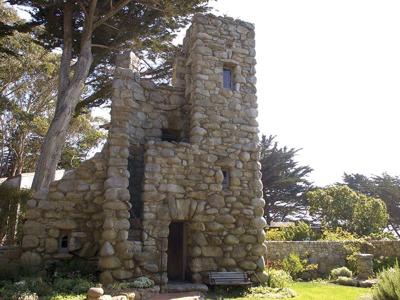
In their Monterey County visit, they had a tour of Robinson Jeffers’ (#346) Tor House with longtime guide and vice president of the Tor House Foundation, Elliot Ruchowitz Roberts [current president of the foundation].
“We had a really incredible time at the Tor House,” Skold says. “I’m a poet and I can’t find the words to describe how amazing and beautiful that place is. I don’t think I’ve been to a grave or home that has such a powerful presence of the poet. His whole life was there. You feel his poetry when you read it in the rocks and the waves and the wind.”
Though Steinbeck is not a poet, they visited the Steinbeck Center because “he’s so epic.” Walter allegedly kissed Rocinante.
In addition to graves, they also visit places where they surmise that a poet’s ashes were scattered. Like at Point Lobos.
“Nora Mae French (#347) committed suicide in George Sterling’s [Carmel] home when she was very young. He was living in Carmel. He was a famous poet in the 20th century. George spread her ashes somewhere in Point Lobos. We stood at The Point near Jeffers’ home and read her poetry. A woman head of the poetry club, Catherine Gable, from Pacific Grove, read one of Nora Mae’s poem’s and I read one.”
He believes that had she lived longer, French might have evolved into one of the great American poets.
(0) comments
Welcome to the discussion.
Log In
Keep it Clean. Please avoid obscene, vulgar, lewd, racist or sexually-oriented language.
PLEASE TURN OFF YOUR CAPS LOCK.
Don't Threaten. Threats of harming another person will not be tolerated.
Be Truthful. Don't knowingly lie about anyone or anything.
Be Nice. No racism, sexism or any sort of -ism that is degrading to another person.
Be Proactive. Use the 'Report' link on each comment to let us know of abusive posts.
Share with Us. We'd love to hear eyewitness accounts, the history behind an article.