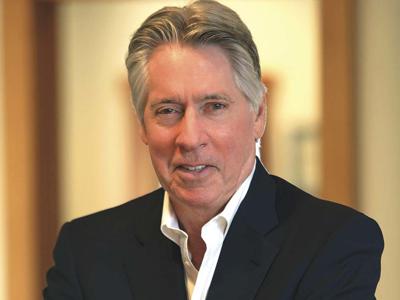

Trust me, you have heard film composer Alan Silvestri’s music. His career began in low-budget flicks in the ’70s before catching his first break doing the funky and synthy music for the TV series CHiPs.
His next break came when he met Robert Zemeckis and did the music for the director’sRomancing the Stone. That was the start of a collaboration that’s included the Back to the Future trilogy, Forrest Gump (for which Silvestri was nominated for an Oscar and a Golden Globe), Cast Away, Flight, every subsequent film that Zemeckis has done.
Non-Zemeckis films that Silvestri scored include Predator 1 and 2, Van Helsing, Lilo & Stitch, Polar Express (he picked up another Oscar and Golden Globe nomination there), The Avengers, The Croods, Allied.
By the way, he’s also a respected winemaker with his own eponymous label. And he’s done almost all of it from the comfort of his Carmel home, where he and his wife have lived for 28 years.
Weekly: Do you work from home?
Silvestri: Yes. Other than the times when we record, where I have to go somewhere with a symphony orchestra, all of the work is done quietly in a room.
Is the majority of film music today recorded by live musicians?
It’s a very direct correlation between the size of the budget. If you’re working on a big-budget film – for instance, Star Wars: Rogue One – that’s an orchestra. But if you’re working on episodic television, for instance, they have [fewer] resources and the composer [may be] asked to create the entire score on their computer.
Are your surroundings conducive to how you work?
Absolutely. For me, it has to do with being surrounded by beauty. There’s a kind of wildness in the Central Coast. I like to think of it in the wine world: they use this term, “terroir,” about the dirt the vines grow in, the climate, the wind direction. All of these kinds of things go into this very complicated equation that ends up with a glass of wine.
With the body of work you’ve created, do you still have self-doubt?
I absolutely do [laughs]. It never goes away. When everyone sits down to begin, the proverbial stack of blank paper sits there and it is daunting. As daunting as it was in the very beginning. Of course I do have the benefit of knowing I have survived on a number of occasions.
For you, is the hardest part of the creative process the beginning?
It absolutely is. There’s a tendency – and I know this from my experience flying airplanes – when crisis arrives, one of the first impulses is to freeze rather than begin to make the ordered, necessary decisions to avoid the crash. That applies to writing music for film for me. I have to begin. The moment you do anything, all of a sudden this panic impulse seems to subside. It’s never changed in 45 years.
(0) comments
Welcome to the discussion.
Log In
Keep it Clean. Please avoid obscene, vulgar, lewd, racist or sexually-oriented language.
PLEASE TURN OFF YOUR CAPS LOCK.
Don't Threaten. Threats of harming another person will not be tolerated.
Be Truthful. Don't knowingly lie about anyone or anything.
Be Nice. No racism, sexism or any sort of -ism that is degrading to another person.
Be Proactive. Use the 'Report' link on each comment to let us know of abusive posts.
Share with Us. We'd love to hear eyewitness accounts, the history behind an article.