Excerpted from an article that was originally published in the Weekly on Aug. 16, 2012.
In the business district of downtown P.G., there’s a shop the size of a moderately wealthy woman’s closet. It’s adorned with vibrant Tibetan peace flags and exudes the scent of burning sage. A single step inside transports customers to a foreign street fair.
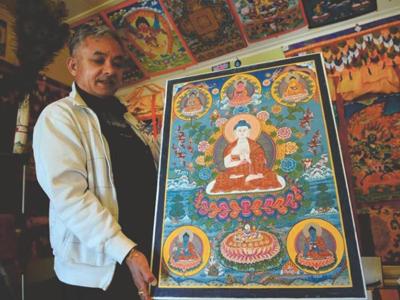
A modest man with a warm smile sits behind the jewelry case at the Himalayan Thangka Gallery and acknowledges customers with a gentle nod. Pratap Lama, a master of the art of thangka painting, emigrated from Tibet in 2008 after having studied under his father until his passing when Lama was 15 years old.
The intricacy of the stories told in layers of pencil, ink and watercolor – and, eventually, crushed 24-carat gold – exceed the typical archive of adjectives. Unfurling a work in progress from its place on a beautifully cluttered shelf, the artist demonstrates the careful process, explaining that a single piece can take months to complete.
“It’s a meditative process,” Lama explains. “With other types of painting, you can talk or look around, but with thangka there are three important elements – hand balance, eye balance and breath balance.”
The artist constructs the canvas by sewing cotton cloth onto a wooden frame, and layering it with a melted mixture of white powdered clay, black glue and water. After it dries, the artist uses a rough stone or a razor to smooth the surface down. He begins to stencil the scene first using pencil and then ink. The process is painstaking; early sketches mirror architectural blueprints, though straight edges are rarely used.
The paint consists of a variety of natural vegetable, herb and mineral substances found in the foothills of the Himalayas. As those are a little hard to come by in this Pagrovian part of the globe, Lama has switched to high-quality watercolors.
He explains there are five core colors artist start with: white for the earth, yellow to represent art, green for water, red to reflect fire and blue for space.
“Thangka tells all about the environment,” Lama says as he strokes his hand over a finished piece. “With two hands we can make anything.”
Watercolor application follows a strict order: dark to light starting with the sky, then the background, followed by dimensional details and finally glistened with gold.
The physical process of the painting is meticulous, but thangka’s larger purpose, the visual retelling of Buddhist history, warrants precision too.
“You have to check to make sure the history is accurate,” Lama says. “My father and his father were Buddhist priests, but I show the Buddhist message through the art, and it has to be correct.”
The discipline stretches beyond the canvas. Lama, who practices both Buddhism and Hinduism, says the artistic process is about learning to control the mind and embed peace and truth in the everyday.
“This is my altar, my chanting room,” he says. “Every morning, for two hours, I chant.”
(0) comments
Welcome to the discussion.
Log In
Keep it Clean. Please avoid obscene, vulgar, lewd, racist or sexually-oriented language.
PLEASE TURN OFF YOUR CAPS LOCK.
Don't Threaten. Threats of harming another person will not be tolerated.
Be Truthful. Don't knowingly lie about anyone or anything.
Be Nice. No racism, sexism or any sort of -ism that is degrading to another person.
Be Proactive. Use the 'Report' link on each comment to let us know of abusive posts.
Share with Us. We'd love to hear eyewitness accounts, the history behind an article.