Excerpted from a story originally published on March 1, 2007
The reflective glow from some 40 imposing gilt frames, polished floors and porthole windows warms the gracefully simple space that is the main gallery of Monterey Museum of Art’s [Pacific Street venue] welcoming the return of local artists of a century ago, a bohemian lot who made their mark on this place, made history and mostly made good.
Artists at Continent’s End: the Monterey Peninsula Art Colony, 1875-1907 is a scholarly and devotional exhibition curated by Scott Shields for the Crocker Museum of Sacramento, but which clearly belongs here. It’s a fascinating, tightly focused show and MMA is appropriately well turned out to exhibit it.
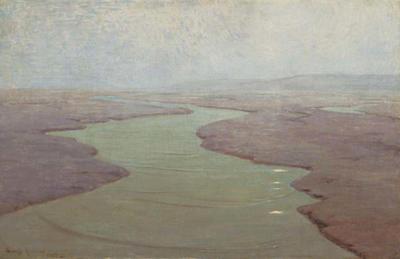
The images are startlingly familiar, but oddly not. Here are those local landmarks, both natural and architectural that have been so constantly painted, photographed, drawn and interpreted in every possible style and medium, through so many expressive filters, that residents must be forgiven for having developed a certain immunity to them. Look again.
These artists came from all over the world to live “a primitive life” in the rural outpost that was the Peninsula at the end of the 19th century. Worldly and idealistic, iconoclastic and spiritual, they worshipped at the church of glorious nature. Plein air painting? When impressionism was still a new idea, these painters were sitting off Point Lobos figuring it out for themselves.
The exhibition is accompanied by an excellent catalog that shows how curator Scott Shields also was drawn to this place and that time. Full of engaging stories, it is also packed with useful facts and images. Shields tells how the Peninsula became a magnet for artists after the works of Jules Tavernier became widely known in the last quarter of the 19th century.
Born in Paris, Tavernier was an ambitious and successful artist who had served as an artist-correspondent in the Franco-Prussian War and worked as an illustrator in London and New York. He and a friend were commissioned by Harper’s Weekly to travel the West and create a pictorial record. The two artists became national celebrities.
In the exhibition catalog, Shields draws a detailed portrait of Tavernier as a huge talent, profligate drinker, poor businessman and true bohemian who, at the height of his fame, commanded prices beyond any other artist in California.
Tavernier usually painted landscapes and historical scenes. He was inspired by the work emerging from the Barbizon region of France, where artists were attempting to convey the “nature of nature” by depicting intimate views in a loose painting style. Tavernier found his ideal subject in the fields, woods and shoreline of the Monterey Bay and its historic adobes and towns.
In spite of his desire to achieve naturalism, Tavernier’s works are among the most melodramatic in the show. However, his famous name brought the eyes of the art world to the Monterey Peninsula and within a few years many international artists settled here, for the beauty certainly, to escape what was becoming an increasingly industrial world, no doubt, but also to be part of the bohemian community.
It is not Tavernier’s work, nor the historical master works of William Keith, nor the haunting experiments in light of Charles Rollins Peters that are the greatest surprise of this show. Rather it is the enlightening collection in that lovely main gallery, within those heavy frames like baroque theaters proclaiming the importance of what is within. These works illuminate the turbulence and demonstrate the synthesis of that period in art.
Impressionism had been introduced just a few decades before. The decorative mannerisms of art nouveau were gaining precedence in the cities of Europe, while the Barbizon painters were working in the fields to interpret nature more naturally; American painting harkened back to an earlier era and had little to distinguish it.
In this one gallery, these influences can all be traced, along with the direct impact of one artist on another in what had become a close-knit community. It seems only right that these works have returned to their source.
(0) comments
Welcome to the discussion.
Log In
Keep it Clean. Please avoid obscene, vulgar, lewd, racist or sexually-oriented language.
PLEASE TURN OFF YOUR CAPS LOCK.
Don't Threaten. Threats of harming another person will not be tolerated.
Be Truthful. Don't knowingly lie about anyone or anything.
Be Nice. No racism, sexism or any sort of -ism that is degrading to another person.
Be Proactive. Use the 'Report' link on each comment to let us know of abusive posts.
Share with Us. We'd love to hear eyewitness accounts, the history behind an article.