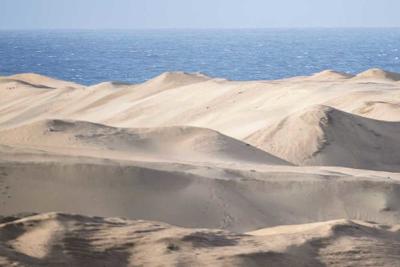

In January 2017, Los Angeles-based journalist Vince Beiser traveled to the Monterey Peninsula to report on a protest that activists staged near the Cemex sand mine in Marina. Beiser was working on a book about sand and he was hoping to incorporate some of the Cemex drama.
That book, The World in a Grain, published this summer, and Beiser was somehow able make a story about one of the world’s most mundane, ubiquitous substances into a ripping, often deeply unsettling yarn. Sand, Beiser tells us, is the primary ingredient of our built environment, from roads to buildings to windows – “It is the substrate of modernity,” he writes.
Yet the right kind of sand for industrial uses, readers learn, is also increasingly hard to find: It would take one-and-a-half Earths to generate the 50 billion tons our civilization currently consumes each year – and our pace of consumption is only going up.
Beiser’s book takes readers on a fascinating journey from the humble beginnings of concrete – a largely sand-based composite the Romans were making as early as the 3rd century BCE – to the first concrete highway (a 24-mile stretch laid in Pine Bluff, Arkansas in 1913) to the sprawling concrete jungles of today’s megacities.
The World in a Grain also covers other uses for sand, including technological breakthroughs it has made possible, and delves into the environmental and social costs of sand mining.
Readers travel to the sand mines of Wisconsin, which yield grains with the ideal attributes for use in fracking, and to Spruce Pine, North Carolina, the source of the purest natural quartz (aka silicon dioxide) on the planet, which is highly sought after by companies that make microchips (hence the name Silicon Valley).
But the most shocking impacts of the sand industry are playing out abroad in places rife with corruption and lax regulation. Since 2014, Beiser writes, sand miners in India have killed at least 70 people, including police officers and public officials, as well as a journalist who was burned to death. In the Middle East, sand is being used to create exclusive island developments off the coast – a process euphemistically called “land reclamation” – that sometimes buries coral reefs and destroys marine ecosystems.
With so much terrain to traverse, the Cemex mine in Marina only gets one page of ink, but local readers probably won’t mind as the mind-blowing facts keep coming. Who knew that the quantity of sand and gravel used to build the Hoover Dam could fill a train 1,300 miles long? Now you do.
(0) comments
Welcome to the discussion.
Log In
Keep it Clean. Please avoid obscene, vulgar, lewd, racist or sexually-oriented language.
PLEASE TURN OFF YOUR CAPS LOCK.
Don't Threaten. Threats of harming another person will not be tolerated.
Be Truthful. Don't knowingly lie about anyone or anything.
Be Nice. No racism, sexism or any sort of -ism that is degrading to another person.
Be Proactive. Use the 'Report' link on each comment to let us know of abusive posts.
Share with Us. We'd love to hear eyewitness accounts, the history behind an article.