
Excerpted from an article that was originally published in the Weekly on May 18, 2017.
At 6pm sharp, a church bell from Liberty Chapel rings out and echoes through the quiet, dimly lit streets of Soledad. Then, like clockwork, women driving older model minivans start collecting into a parking lot. They park, then begin walking toward a small portable building.
Once inside, they make quick work preparing their soon-to-be classroom. In one corner of the room, bread is lightly toasted, spread with Country Crock “butter,” then sprinkled with sugar. Coffee is poured, emptied, then refilled again. In a side room, a few small children are corralled around tables equipped with crayons, markers and construction paper. The women pull aging cushioned chairs together to form a half-circle.
Some scoot their chairs inches closer to their friends as they keep chatting away, waiting for their instructor, Gabriel Guillén, a professor at Middlebury Institute of International Studies in Monterey.
Guillén arrives late, but this cohort of Spanish-speaking women is happy to sit and wait. That’s because the 90-minute class, which happens every other Thursday, is one of the few chances this group has to practice their English.
Members of this cohort were all recruited through word of mouth by Mujeres en Acción, an offshoot of the Women in Action program that seeks to empower women living in rural areas. The class is part of a curriculum developed by Guillén and his former graduate student April Danyluk in 2015, who wanted a meaningful cultural and language exchange, but didn’t have enough money for pricey study-abroad trips in Spain or Latin America.
“We instead decided to look at what we had,” Guillén says, “and then we saw Salinas.” The majority-Latino population in Salinas and South Monterey County provided the perfect lab, offering both Spanish language practice and cross-cultural exchange.
Guillén set up two classes: One in Salinas at St. Mary’s Church where English-learners are men and women, and the Thursday-night group in Soledad, where students are all women from Mujeres in Acción. All of the Spanish-learners come from MIIS.
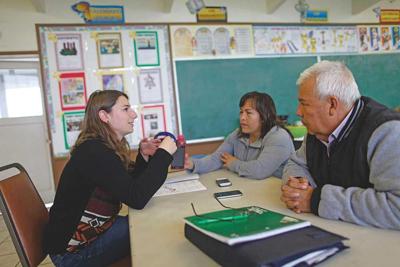
Guillén bases the lessons less on traditional lecture mode and more on conversation. Called “tandem learning,” the teaching style emphasizes student-to-student interaction with back-and-forth conversation on meaningful, real-life subjects – the kind of conversation a student would get studying in another country.
When Guillén and about 10 Spanish-language students from MIIS arrive in Soledad, Guillén asks everyone to arrange themselves according to fluency. Starting from the left, Spanish-learners line up from novice to confident. Their half-circle is completed with the mirror image, but with the English learners. When the students finish shuffling, their respective and equal partners should be standing directly across from them.
“This isn’t about one student learning more than another, or using their partner so they can practice,” Guillén says. “It’s about mutual respect and confidence.”
From there, it’s a series of activities in both languages. It could be a simple introduction – name and age, or an account of one’s day, for instance. The idea is just to talk. One MIIS student describes her family in halting Spanish while her partner nods gently in encouragement.
“Sometimes we just end up talking off topic,” Guillén says. “But it’s better for [the students] to have engaging conversations than taking tests all the time.”
Even shy students, like 22-year-old Martha Zepéda, seem engaged. Zepéda is originally from Jalisco, Mexico, and is taking English classes at the Salinas Adult School. She comes to the Thursday-night classes for a chance to speak English freely. “It’s hard to get all my friends to come,” she says, noting that her friends are more or less in the same situation as her: stay-at-home moms or working moms who are mostly isolated from English speakers.
“If I stay home, I can’t make my English better,” she says.
(0) comments
Welcome to the discussion.
Log In
Keep it Clean. Please avoid obscene, vulgar, lewd, racist or sexually-oriented language.
PLEASE TURN OFF YOUR CAPS LOCK.
Don't Threaten. Threats of harming another person will not be tolerated.
Be Truthful. Don't knowingly lie about anyone or anything.
Be Nice. No racism, sexism or any sort of -ism that is degrading to another person.
Be Proactive. Use the 'Report' link on each comment to let us know of abusive posts.
Share with Us. We'd love to hear eyewitness accounts, the history behind an article.