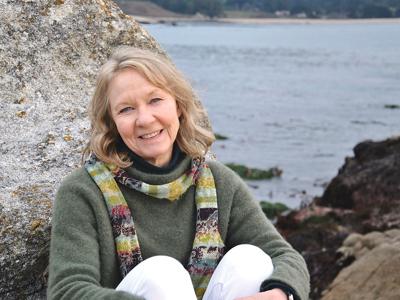

Carmel is a good hiding place; Lack of addresses and cottages concealed by trees favor privacy. This is where New York Times bestselling author Meg Waite Clayton has been tucked, since 2021, and this is where the characters of her latest novel, Typewriter Beach, kept out of sight.
The novel tells the story of a Hitchcock starlet, Isabella Giori, who in 1957 is sent from Hollywood to lie low until summoned back. Living in a fictional cottage with a view of Robinson Jeffers’ Hawk Tower, she meets a screenplay writer, Léon Chazan, who moved to Carmel after being blacklisted from Hollywood during the Red Scare. That’s just the beginning of the story.
Years later, in 2018, Chazan’s granddaughter Gemma, also a screenwriter, visits the cottage where he lived and died. Soon she begins to uncover a secret that will change everything, including her family’s story.
Clayton, the author of nine novels, says she had a lot of fun discovering Carmel through the research for Typewriter Beach, gleaning through archived newspapers from the 1950s. She also learned about the connection between Carmel and Hollywood at the end of the studio contracts era.
Isabella experiences all the pressures stars of the era suffered through – forced to get a nose job or to lose weight. Then there’s the matter of ideological compromise portrayed by Leo Chazan.
Clayton came of age in the 1970s and straddled the time when it was common for women to be housewives and the time when more became professionals. All her novels are written from a female perspective, from her debut, The Language of Light, about a widow starting over in Maryland, to more recent novels, such as The Last Train to London, set in the Kindertransports that carried thousands of children out of Nazi-occupied Europe, or The Race for Paris that finds journalists converging toward Paris to record its liberation from the Germans.
A big Hitchcock fan, Clayton knew about blacklisting in Hollywood and was always “appalled by the idea.” Making comparison to current times, she says that she wanted to capture one of “those moments of extremes in the society,” when people live in fear and reality seems absurd. “They bring up the best and the worst in people,” she adds.
(0) comments
Welcome to the discussion.
Log In
Keep it Clean. Please avoid obscene, vulgar, lewd, racist or sexually-oriented language.
PLEASE TURN OFF YOUR CAPS LOCK.
Don't Threaten. Threats of harming another person will not be tolerated.
Be Truthful. Don't knowingly lie about anyone or anything.
Be Nice. No racism, sexism or any sort of -ism that is degrading to another person.
Be Proactive. Use the 'Report' link on each comment to let us know of abusive posts.
Share with Us. We'd love to hear eyewitness accounts, the history behind an article.