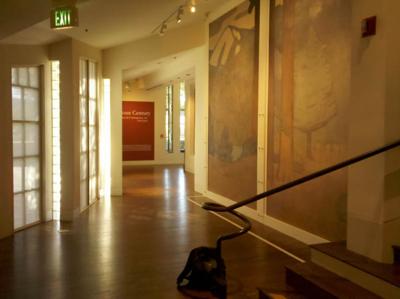

Walking down the first light-infused hallway at Monterey Museum of Art at La Mirada, you don’t so much encounter the first work of its two new exhibits. It encounters you. Dramatically.
It’s one of four Gattardo Piazzoni murals the museum received on long-term loan from the Fine Arts Museums of San Francisco of From Dawn to Dusk: Gottardo Piazzoni’s Final Murals. It’s a ceiling-high, imposing thing called “Night.” It was the last mural Piazzoni would paint.
“He knew he was dying,” says Dr. Eric Del Piero, one of the museum’s trustees. “He died six months later. It’s about mortality.”
Nearly the whole middle length of the mural is swallowed up by a shadowy forested mountainside above a dark body of still water. Jutting out into the water is what looks like a rock slab with a lone person sitting on it. Maybe. It could be a boat, or a coffin. And that may not be a person sitting on it. The interplay of paint, the murkiness of it, allows different shapes to arise, like cloudwatching, so the viewer will see what the viewer will see. I’ve seen a turkey head, the fist of a communist proletariat poster, Janis Joplin, and three elves and a teddy bear huddled around a campfire. It’s fun. You should try it.
Piazzoni is a pre-eminent modernist artist who made California – he lived, partly, on his father’s dairy ranch in Carmel Valley – more than just a home, but a subject of his paintings.
“Some reporter asked him about religion,” Del Piero says. “And he said, ‘I think it’s California.’”
The landscape here would influence his art throughout his life, though he mixed it with his European studies at the Academie Julian and the Ecole des Beaux-Arts in Paris.
“He [took] the sensibilities of the Nabis movement, the post impressionists in France, Gaughin, and Japanese prints,” says the museum’s executive director E. Michael Whittington. “And created a whole new visual aesthetic. He was respected in his day, but fell out of favor. We and the deYoung Museum believe Piazzoni is one of the great early 20th-century artists in California.”
To that end, these four murals, part of a series of 14 Piazzoni was commissioned to paint for the San Franicsco Public Library – the 10 others are on display at the deYoung – are an effort to restore that prominence. The art looks worthy of it.
The second exhibition, Glorious Century: Modern and Contemporary Art, 1910-2010, also demands attention, and that it’s only slated to stay up for one glorious month (it comes down May 29) adds urgency to it. It’s big and ambitious. Those works come from the museum’s permanent collection and are divided among the three galleries: artistic and striking black and white photographs, early modern work, and contemporary art downstairs.
“Trees don’t have pink trunks,” Del Piero says of one of John O’Shea’s paintings. “These painters went from plein aire to modern, a transition of 10 years. These modernist paintings didn’t sell well. They weren’t impressionists, they were expressionists.”
“They” include John Sloan, Mark Tobey, Richard Partington, Armin Hansen, E. Charlton Fortune and others. That they didn’t sell well indicates that their new approach to painting, which today looks unthreatening, confused viewers who had been nurtured on the niceties of impressionism and plein aire.
The photography segment of Glorious Century is stacked with some of the most influential photographers around. Garry Winogrand’s “New York City” is a street scene of a whimsical woman in a phone booth offering the world a peek up her skirt. Bettina Rheims’ “Carol W.,” a portrait of a stoic woman with a daringly flung open shirt gazing through smeared mascara, is hard to not look at. The names of the other photographers – Robert Mapplethorpe, Imogen Cunningham, Ansel Adams, Wynn Bullock, Ruth Bernhard – are impossible to ignore.
Downstairs in the Dart Gallery awaits diverse contemporary works by Mel Hanson, Walter Snelgrove, George Abend, Jennifer Starkweather and others.
Ingrid Calame’s abstract mural, colorful flecks of paint in patterns that suggest groups of islands, looms over the gallery. It stretches from floor to ceiling on the wallscape of the gallery.
“Summer” by George Rickey is a striking, contemplative metal kinetic sculpture, comprised of six “swords,” 10 feet long, sticking up like blades of grass. And the kicker: it moves. Air currents get it going, says Whittington, when someone walks by. They’re so precisely balanced with counterweights that they sway as the kinetic waves travel through them. It’s brilliant, like the wider exhibitions: You encounter the art, and the art encounters you.
MONTEREY MUSEUM OF ART AT LA MIRADA is open 11am-5pm Wednesday-Saturday and 1-4pm Sunday, at 720 Via Mirada, Monterey. Painter Mari Kloeppel talks about her paintings 3pm Saturday, May 7, at MMA Pacific, while artist Barry Masteller does the same 10:30am Wednesday, May 11, at La Mirada. $5 for adults, $2.50 for students and military, free for kids 12 and under. 372-5477, www.montereyart.org.
(0) comments
Welcome to the discussion.
Log In
Keep it Clean. Please avoid obscene, vulgar, lewd, racist or sexually-oriented language.
PLEASE TURN OFF YOUR CAPS LOCK.
Don't Threaten. Threats of harming another person will not be tolerated.
Be Truthful. Don't knowingly lie about anyone or anything.
Be Nice. No racism, sexism or any sort of -ism that is degrading to another person.
Be Proactive. Use the 'Report' link on each comment to let us know of abusive posts.
Share with Us. We'd love to hear eyewitness accounts, the history behind an article.