
In the last 10 years, the federal government has spent $17 million to encourage Americans to read books through a program called the Big Read. It’s administered by the National Endowment for the Arts, which brings the program into different communities across the country to foster more reading, thinking and talking, which they believe “makes us more active and aware citizens.”
They choose a book around which to build their nationwide campaign, then grant money and materials to arts organizations that apply and show that they can deliver related events of “artistic excellence and merit” to their respective communities.
The National Steinbeck Center was granted $14,000 as one of 75 recipients this year. They’ve been here before, as a host of the 2007 Big Read for Steinbeck’s The Grapes of Wrath, and 2008’s campaign on Ray Bradbury’s Fahrenheit 451.
Other Big Read books have included Edwidge Danticat’s Brother, I’m Dying, Yu Hua’s To Live, and Louise Erdrich’s Love Medicine. The NEA’s going for diversity and depth. They got both in this year’s book, Sun, Stone and Shadows: 20 Great Mexican Short Stories. It was edited specifically for the Big Read by Jorge F. Hernandez to give readers a snapshot of Mexico through writers such as Carlos Fuentes, Rosario Castellanos, Sergio Pitol and Elena Garro.
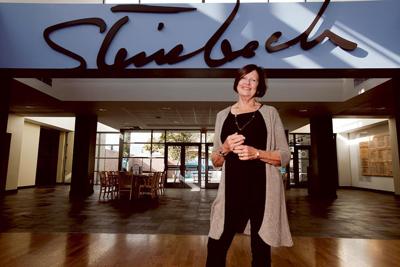
National Steinbeck Center Director Susan Shillinglaw touts the stories as both historical (including the “The Carnival of the Bullets,” about Pancho Villa’s “executioner”) and magical realist, which she describes in an email as “the floating division between what is real and visionary, a porous boundary in some Latin American literature.”
Steinbeck offers a path to Mexico because, Shillinglaw says, much of his work from the 1930s-’50s involved Mexicans or Mexican Americans.
The 40-something Big Read events stretch out from the National Read a Book Day pre-event on Sept. 6 to Día de los Muertos and the NEA Big Read closing party on Nov. 1.
In between lies a profusion of talks, receptions, tours, films, contests and performances – all free. The Steinbeck Center is partnering with a bunch of local arts and education organizations including Hijos del Sol, Monterey Public Library, Hartnell College and others.
And the list is still growing. Just last week, Eric Mora, the Steinbeck Center’s marketing and membership director, was talking with the Salinas Valley Adult Education Consortium and CSU Monterey Bay’s Osher Lifelong Learning Institute.
The Hola Mexico Film Festival, Sept. 9-15, wasn’t officially part of the Big Read events, but because the festival content is related to Mexico, its serendipitous schedule got pulled into the orbit as an ancillary event.
“To embrace her was to embrace a piece of night tattooed with fire.”
The Big Read officially kicks off 3pm this Friday, Sept. 16, at the National Steinbeck Center. There, all the partner orgs will be on hand with tables and literature extolling their work, Steinbeck Center archivist Lisa Josephs will give visitors a peek into the archives reading room (including the manuscript for The Pearl and posters for the films Viva Zapata and Tortilla Flats), and tacos will be served.
The centerpiece, though, will be Western Stage’s adaptation of the first story from Sun, Stone and Shadows, Octavio Paz’s “My Life with the Wave.” It’s a lyrical, funny and surreal number from the renowned Nobel Prize-winning Mexican poet, about a man and his relationship to and life with a literal wave:
“She was so clear I could read all of her thoughts,” it goes. “On certain nights her skin was covered with phosphorescence and to embrace her was to embrace a piece of night tattooed with fire.”
Western Stage’s Artistic Program Director Melissa Chin-Parker says anticipation is high. “Everyone’s wondering how we are going to interpret it,” she says. “We want movement to [reflect] magical realism without being literal. We talked about what the wave is – a man and the writing process. He’s struggling with the idea of the story.”
In the following weeks, speakers from CSUMB, Stanford, MPC and the city of Monterey will add perspective in talks addressing “What can literature tell us about ourselves?” and “When we were Mexico: A frontier province and it’s capital – Monterey.”
Maya Cinemas is showing four of Steinbeck’s films either set in Mexico or peopled with Mexican characters. Hijos del Arte is sponsoring a contest in which artists ages 17-30 interpret each of the 20 stories from Sun, Stone, and Shadows, a group show that opens Oct. 1-2 at the Steinbeck Center in conjunction with the Open Studios Tour. There’s lots more.
“A short story depends on compression – how to convey characters, situations, a climax briefly and efficiently,” Shillinglaw says. “What is engrossing about a short story collection is the speed with which a reader gets into – and through – a situation.”
In that way, the Big Read events mirror the book it revolves around: a series of smaller events that add more and more dimension to a bigger story of the character of Mexico.
(0) comments
Welcome to the discussion.
Log In
Keep it Clean. Please avoid obscene, vulgar, lewd, racist or sexually-oriented language.
PLEASE TURN OFF YOUR CAPS LOCK.
Don't Threaten. Threats of harming another person will not be tolerated.
Be Truthful. Don't knowingly lie about anyone or anything.
Be Nice. No racism, sexism or any sort of -ism that is degrading to another person.
Be Proactive. Use the 'Report' link on each comment to let us know of abusive posts.
Share with Us. We'd love to hear eyewitness accounts, the history behind an article.