
At the moment of its ultimate glory around 2007 and 2008, everybody in Monterey County talked about “the film festival” and how the Golden State Theatre, where the festival used to take place, was under a siege of 2,500 festival-goers, bursting on Friday and Saturday nights.
Not every chapter of the United Nations Association of the United States of America (UNA-USA) has a film festival. There might be some that do, and many hold a documentary screening from time to time, but it’s the one born in Palo Alto and its fiercely independent Monterey Bay offspring that count, presenting their communities with an annual selection of fresh international documentaries.
“I did a count of the countries we had films from,” says Lisa Wartinger, a chapter member and festival-goer since 2004. “At least 64 over the years.” Those include distant locations such as Bangladesh or Papua New Guinea, bringing stories from all over the globe to local audiences.
“The UN Association is a private nonprofit organization that is not part of the U.N., but builds support for it,” explains Larry Levine, who started the festival locally and served as president of the Monterey Bay chapter of the UN Association, or 14 years. In 1998 – he proceeds with the story – Jasmina Bojic from UN Association in Palo Alto started a film festival that a couple of years later allowed other “travel” festivals in other locations. “We were first to raise the hand,” Levine says.
The start was memorable and a 2000 press release announced that the Monterey Bay Chapter of the United Nations Association and this newspaper, then called Coast Weekly, in association with CSU Monterey Bay’s Institute for Teledramatic Arts & Technology, joined to present a two-day international film festival at the World Theater at CSUMB.
Over the course of the next decade, the Monterey Bay festival became so big and successful that, in 2008, it demanded more creative control.
“We wanted to have our own access to films,” Wartinger says, “and more freedom.”
The two festivals parted ways in 2008, and since then local committees make their own film selection. The event is completely run by volunteers – no budget, no staff. Despite that, the magic worked – sometimes with different lineups of films on four respective days, presenting documentaries of various lengths and of different topics.
Levine still tunes into the Palo Alto-Stanford festival, and the two events have a good relationship. “One thing that surprises me is that each year we come up with different films. And we both are looking for ‘the same films’ – international films on themes of war and peace and poverty and global health and the environment. Yet we almost never show the same films.”
Two committees are responsible for the film selection process, Levine says. “One for research of the films and another to select the best program… It’s not always ‘the best’ films.”
Colors and music are also important, just as the “uplifting” value of the story – no one wants to watch a lineup of movies about homicide, no matter how educational they are.
“We try to raise consciousness, not funds,” Levine repeats – this, he says, has been the festival’s mantra over the years. Ultimately, their goal is not to profit but to introduce people to global issues – “especially young people,” he says, dreaming of local teachers of global studies or environmental affairs that would give their students credit for attending a festival and analyzing a selected issue.
That’s why they keep the price of tickets low ($10 this year), with students at all educational levels able to attend for free.
“Santa Catalina’s Peace and Justice Club has been involved,” Wartinger says, referring to Santa Catalina School in Monterey. She adds that Oct. 24 is U.N. Day – the anniversary of the day in 1945 that the U.N. Charter went into force. This year, the theme of the day is food security – the film festival will be a local celebration of U.N. Day.
What to expect this year? Each committee member has their favorites, and both Wartinger and Levine have their film recommendations.
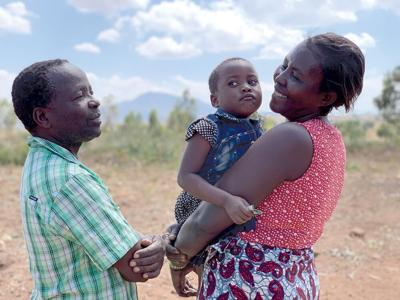
“They all moved me in different ways,” Wartinger says about the eight films that will be shown this year (five on Friday and three on Saturday). They vary in length, from the 13-minute long A Concerto is a Conversation (USA) to the 74-minute long The Ants and the Grasshopper (Malawi/USA).
“Maybe the most important one this year is Fly So Far, a cautionary tale of what happens when the government seeks to criminalize women’s reproductive rights,” Wartinger says of the Salvadoran film screening on Friday. It’s a specific story to a specific place, but one with a more universal theme, like many of the films shown.
“The two films that touched my heart the most are two short films that come first on Friday evening,” Levine adds. “A Concerto is a Conversation was nominated for the Academy Award for best short documentary. It deals with a young musician and his 90-year-old grandfather.
“The second one is Invasion by a group of native peoples in Canada that resisted incursions by private companies and their own Canadian government into their land.”
(0) comments
Welcome to the discussion.
Log In
Keep it Clean. Please avoid obscene, vulgar, lewd, racist or sexually-oriented language.
PLEASE TURN OFF YOUR CAPS LOCK.
Don't Threaten. Threats of harming another person will not be tolerated.
Be Truthful. Don't knowingly lie about anyone or anything.
Be Nice. No racism, sexism or any sort of -ism that is degrading to another person.
Be Proactive. Use the 'Report' link on each comment to let us know of abusive posts.
Share with Us. We'd love to hear eyewitness accounts, the history behind an article.