
Philip Glass has been blending philosophy, science, spirituality, world music, visual arts and collaboration into his music from early on. His latest Days and Nights Festival has a dozen such examples in two weeks, starting with music pilgrim Daniel Medina from the Wixarika indigenous people from Santa Catarina Cuexcomatitlán, Jalisco, Mexico.
According to a festival statement, the songs are “representations of Daniel’s conversations with the deities that govern the sacred places he continuously visits.”
It’s part of Glass’ intent to share some of the wisdom he’s encountered in his travels, and to discover “the ultimate origin of music itself.”
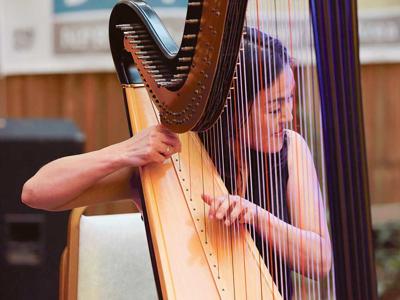
He’s joined many musicians, artists and thinkers on that journey over the years. Lavinia Meijer has been one of them. She is a 35-year-old harpist who grew up and was musically trained in Holland, and believes that the arts are the “binoculars to the future.”
“Holland is a good place to live as an artist,” she writes by email. “It has a very diverse spectrum of cultures and arts.”
She’s performed as a soloist with orchestras, in festivals all over the world, and debuted in Carnegie Hall in 2007. She’s also well-versed in jazz, pop, modern music and Philip Glass.
“His music breaks open all registers of inner emotions,” she says. “It truly moves something inside of me, makes me feel more alive and connected to myself and the world around me. It stands for life and has a very strong visual energy.”
She says the flurry of shifting notes in Glass’ music demands a lot of concentration, strength and stamina, especially on an instrument that exerts a couple hundred pounds of tension on the frame.
“I grew an extra muscle in my arm throughout the years,” she says. “I call it the Glass-muscle.”
She’s performed at the Days and Nights Festival before, playing on a piece in which Glass wrote music that weaved through and around Jerry Quickley’s spoken word poetry about the FBI and Edward Snowden.
“The way Philip Glass had worked, it was mind-blowing,” Meijer says. “Not only does he connect his music with different styles and art forms, he also connects people through the music.”
Through Glass, she’s played with Iggy Pop, Alabama Shakes, Sufjan Stevens, Basia Bulat, Foday Musa Suso, Patti Smith and Tenzin Choegyal.
At 7pm on Sunday, Sept. 30, at Henry Miller Library, Meijer is playing with Glass and Choegyal, music from the film The Last Dalai Lama, for which there is no score but is passed down by ear in the Tibetan tradition.
Dennis Russell Davies is an American conductor and pianist who – after founding the American Composers Orchestra in the 1970s and directing the Cabrillo Festival of Contemporary Music in Santa Cruz from 1974 to 1990 – worked extensively in Europe, including, from 2002-17, as chief conductor of the Bruckner Orchestra Linz and the Linz Opera.
He is the authority on Philip Glass’ music. He’s conducted almost all of his friend’s symphonies, including premieres of his 10th in Linz and 11th at New York’s Carnegie Hall. Glass dedicated his 5th symphony to Davies.
“There is a directness and honesty in his musical language,” Davies says from Linz, Austria. “He has an original voice. He appeals to intellectual side as well as the emotional side. The music he’s composed over these many years has appealed to a very wide audience, many of whom are not traditional concert or opera goers. It’s inspiring.”
In 2003 Davies performed in concert with pianist Maki Namekawa at the Arts Electronica Festival in Linz, and they’ve been together – as a married couple and as an acclaimed piano duo – ever since.
On Saturday, Oct. 6, 7pm at Golden Bough Theatre in Carmel, they are performing the popular symphonic suite from West Side Story in honor of Leonard Bernstein’s 100th birthday, Namekawa is performing Glass’s “Mishima” from the biographical film about writer Yukio Mishima, Davies performs from composer Lou Harrison’s Third Piano Sonata, then the couple join forces on Glass’s 4 Movements for 2 Pianos, which was written for them.
Two years ago, Namekawa performed Glass’ 20 Etudes with Glass at the Days and Nights Festival at Henry Miller Library – the first six of them were written for Davies, the last 10 for Namekawa.
“Philip told me [Big Sur] is a beautiful place, the sunset is beautiful, the air is beautiful,” says Namekawa, also speaking from Linz. “People coming to the festival are different from a normal concert hall. [It] is more lively.”
She says when she played at the Henry Miller Library, in the open air, there were enough bugs to call for mosquito spray. But she appreciated the picnic lunch concert on the library’s lawn, the informal way people could just enjoy the music.
“His music, for me, is like philosophy,” she says. “I’m Buddhist. He can talk about everything in his music, but the way is very simple. [It’s] like Japanese culture.”
Philip Glass’ music is like a lot of things because he has incorporated so much into it that it becomes reflections on the world.
THE 7TH PHILIP GLASS DAYS AND NIGHTS FESTIVAL runs Sept. 30 to Oct. 7 at venues in Big Sur, Carmel and Salinas. $45-$115; some events free. 626-3340, philipglasscenter.org
(0) comments
Welcome to the discussion.
Log In
Keep it Clean. Please avoid obscene, vulgar, lewd, racist or sexually-oriented language.
PLEASE TURN OFF YOUR CAPS LOCK.
Don't Threaten. Threats of harming another person will not be tolerated.
Be Truthful. Don't knowingly lie about anyone or anything.
Be Nice. No racism, sexism or any sort of -ism that is degrading to another person.
Be Proactive. Use the 'Report' link on each comment to let us know of abusive posts.
Share with Us. We'd love to hear eyewitness accounts, the history behind an article.