
>>LITERATURE
“The world is so rich,” wrote Henry Miller, “simply throbbing with rich treasures, beautiful souls and interesting people. Forget yourself.”
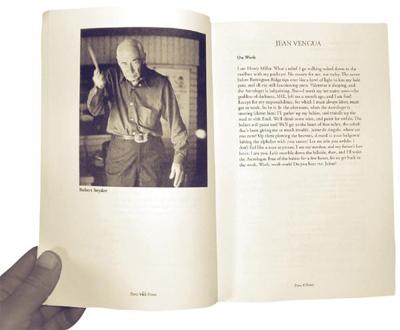
Ping•Pong, the original literary magazine published by the Henry Miller Library 11 years ago, would not forget Miller. Instead, it memorialized the fearless writer.
“It was Miller-centric,” says Magnus Toren, executive director of the Library, “dedicated to the life and works of Henry Miller, as well as the activities of the Library.” The bulk of its pages were given to essays and photographs by mostly American writers and photographers. It published only two issues.
Today Ping•Pong is back and, according to editor Maria Garcia Teutsch, “it is a different beast,” in touch with “today’s artistic gestalt” and displaying the world of “rich treasures, beautiful souls and interesting people” that Miller celebrated. It is bigger and more international than its original incarnation, and thanks to the Internet, able to reach parts of the globe that its predecessor did not.
The new Ping•Pong contains works by writers and artists from Japan, Germany, Brazil, Russia, India and England, often published in the writer’s native language with English translation. And whereas the original Ping•Pong focused on essays, the new Ping•Pong publishes poems, fiction, photos, art and a few uncategorizable written works. While the original ran a modest 70 pages or so, the new Ping•Pong is a 183-page book.
The contributors include some obscure writers and others who are more well-known, like surrealist poet Nakahara Chuya. “He’s a rock star in Japan,” Teutsch says, “but this is his first translation into English in North America.”
What ties the pieces together is a spirit of creative freedom, one of Miller’s most profound legacies. His books were banned here and in England (they were contraband, attainable only through underground channels) until a 1964 Supreme Court ruling deemed his Tropic of Cancer (1934) not obscene.
Ping•Pong’s contributors play liberally in the wider pastures of artistic license. The content ranges from personal stories to Dadaist nonsense, political tracts to deconstructed plays.
From a Charlie Anders story: “I have two lovers, plus I can go to polite orgies and have above-board sex with geeks, hippies and Goths. Why shouldn’t that be enough?”
Literary journals often exist on the fringe in the United States, too inscrutable or simply too small to achieve broad attention. According to Toren, that’s fitting. “It’s OK to be on the fringe,” he says. “Miller was on the fringe. He was sort of a working man’s literary hero.”
The magazine’s team plans to employ the Internet to expand readership.
“The Web has changed the paradigm for us,” says Toren. He adds that Henry Miller has always been more popular overseas than in the States.
“People are writing and submitting from all over the world,” says Teutsch. “I’ve had friends in Burkina Faso in West Africa go to the Web page to see the magazine. The poorest of my students [at Hartnell College] have access to things they didn’t have years ago.”
Miller, along with fellow writer and sometime lover Anais Nin, inhabited artistic and writing circles that included a constellation of luminaries like Aldous Huxley, Norman Mailer and William Carlos Williams. Besides serving as a memorial and scholarly source for Miller’s work, the mission of the Library is to produce that same creative environment for artists and writers today. By extension, Ping•Pong follows suit.
“The magazine is a manifesto—a platform. It’s important to create a space for these artists,” says Teutsch. To that end, the Henry Miller Library has assembled many of this issue’s writers and artists to read at the Ping•Pong “re-launch” party. The gathering of like minds and artistic souls over wine, cheese, readings, film and frivolity promises a faithful conjuring of the Miller/Nin atmosphere. Party-goers are encouraged to dress as their favorite author/artist or work of art.
Another legacy that Miller left in his wake is the spirit of experimentation. Unlike many provocative writers whose works simmer and cool over the years, Miller’s writings, with its crudity and sexual explicitness, says Toren, “can still be off-putting to modern sensibilities.”
Ping•Pong picks up that torch with its selection of innovative and experimental works by its contributors, described as “heirs to Miller’s legacy.” (The Web site offers excerpts.)
“We may not be mainstream,” says Teusch, “but what we are publishing, people will be reading 100 years from now.
“Ping•Pong is out there with the condors, on the edge of the continent, waiting for overseas arrivals to our shore.”
THE PING•PONG launch party starts at 5pm, on Saturday, at the Henry Miller Library, Highway 1 a quarter-mile south of Nepenthe Restaurant in Big Sur. Admission is free. 667-2574 or henrymiller.org for more information.
(0) comments
Welcome to the discussion.
Log In
Keep it Clean. Please avoid obscene, vulgar, lewd, racist or sexually-oriented language.
PLEASE TURN OFF YOUR CAPS LOCK.
Don't Threaten. Threats of harming another person will not be tolerated.
Be Truthful. Don't knowingly lie about anyone or anything.
Be Nice. No racism, sexism or any sort of -ism that is degrading to another person.
Be Proactive. Use the 'Report' link on each comment to let us know of abusive posts.
Share with Us. We'd love to hear eyewitness accounts, the history behind an article.