
The Days and Nights Festival is like Philip Glass’ playlist come to life – on shuffle. You never know what combination of music, theater, film, lectures, poetry or dance will appear. This time around – the festival’s ninth year – there’s contemporary, jazz and world music from Philip Glass, Foday Musa Suso and Aaron Dieh; an environmental presentation by Elin Kelsey; and a tribute to influential avant-garde theater playwright and director María Irene Fornés. (A disclosure: My wife, Enid Baxter Ryce, is the festival’s community programs curator.)
Two big new names on the marquee are Danny Elfman and Dave Harrington.
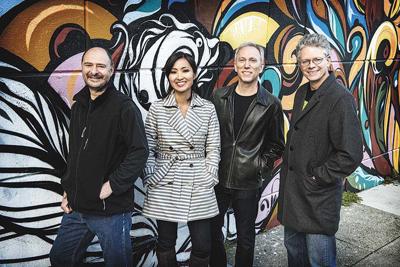
Harrington, a violinist, founded Kronos Quartet in 1973 after hearing George Crumb’s Black Angel. Kronos is probably the most famous string quartet in the world, having made a name by doing things other string quartets don’t do. They have had hundreds of pieces of original music and arrangements written for them; they’ve recorded more than 60 albums; they’ve performed music by Thelonious Monk, Jimi Hendrix and Sigur Ros; they collaborate on creative and innovative projects.
With composer Terry Riley they did “a NASA-commissioned multimedia ode to the Earth and its people that features celestial sounds and images from space.”
From the beginning, Kronos Quartet has redefined the string quartet.
“I don’t know what to call our work,” Harrington says from his home in San Francisco. “I really don’t have a word for it. Kronos would not exist without the tradition that Haydn began in the 1770s, and Mozart, Beethoven, Schubert, [continued] by Brahms, Dvorak, Debussy, Ravel, Terry Riley, Betty Carter, Laurie Anderson. All I can call it is the music that we play and the work that we do.”
Their part of the festival (7:30pm Sat, Oct. 5, at Henry Miller Library) is an autobiographical documentary called A Thousand Thoughts. It’s hard to define. Kronos plays along with it live, and filmmaker Sam Green – he’ll be at the festival too – speaks during it. There are film interviews with collaborators like Glass, Tanya Tagaq and Steve Reich. It premiered at Sundance in 2018 and Newsweek called it “easily the festival’s most mind-blowing experience.”
“It’s partly a concert, film, soundtrack, talk,” Harrington says. “All of it adds up to learning more about the group and learning about music itself.”
Harrington says young people are vibing with it, which makes him happy.
“Music is always young,” he says. “It always starts over. It can be the oldest music in the universe and it’s still new.”
Harrington says he made the decision to be a musician when he was a teenager, and would not be deterred no matter what was happening in society, the world, the universe: “I didn’t care.”
“As a way of life, I’m very happy. I don’t understand how everybody in the world doesn’t want to be a musician.”
Now on to Danny Elfman. He was the lead singer and songwriter for influential ska-new wave-punk-world-rock band Oingo Boingo for 17 years. He went on to write music for films includingBatman, Good Will Hunting, Men in Black, almost all of Tim Burton’s films starting with Pee Wee’s Big Adventure. Oh, and he also wrote the theme song for The Simpsons.
But he’s been navigating a newish phase of his music career: contemporary classical. The thing is, it hasn’t been universally embraced. “Symphonies see me as an interloper. That fuels me,” he says from his studio in Los Angeles where he’s working on The Voyage of Doctor Dolittle and a commission for the National Youth Orchestra of Great Britain. “When I started a rock band, we were neither punk nor pop. As a film composer, I had 10 years of intense hostility as an intruder. Once again, my third time out, I’m breaking into a party where I am unwelcome.”
He says that’s where he likes to be. When he was writing a violin concerto, Eleven Eleven, it was a big challenge.
“It was the hardest thing I had ever done in my life,” he says. “When I finished it, it felt so good embracing the discipline it took.”
He says the source of all this challenge has to do with formal training – of which he’s had none. But he sees an opportunity.
“My feeling is that symphony orchestras have two modes – the big classics, or modern. In general it’s inaccessible to common people. I felt, these people can be brought in.”
He’s comfortable in an in-between space, a space in need of a bridge. That’s where Philip Glass comes in.
“Philip Glass was as influential to me as Stravinsky. When I was 17, a friend of mine played meRite of Spring. It opened me up to 20th-century classical music. It lead to Bartok, Ravel, then Shostakovich, Prokofiev. That was it. In the same way, [Glass’ film scores for] Koyaanisqatsi andPowaqqatsi are it. It’s an original language.”
Glass wrote a composition, Perpetulum, for an inventive percussion quartet called Third Coast Percussion, which uses everything from marimbas, drums and chimes to bells, singing bowls and found objects. He then asked Elfman to do the same, which he did.
Both composers will speak 7:30pm Thursday, Oct. 10, at the Henry Miller Library at the festival concert in which Third Coast Percussion plays their compositions (Elfman’s is a world premier). In that venue, it should sound like magic bouncing around in the air.
(0) comments
Welcome to the discussion.
Log In
Keep it Clean. Please avoid obscene, vulgar, lewd, racist or sexually-oriented language.
PLEASE TURN OFF YOUR CAPS LOCK.
Don't Threaten. Threats of harming another person will not be tolerated.
Be Truthful. Don't knowingly lie about anyone or anything.
Be Nice. No racism, sexism or any sort of -ism that is degrading to another person.
Be Proactive. Use the 'Report' link on each comment to let us know of abusive posts.
Share with Us. We'd love to hear eyewitness accounts, the history behind an article.