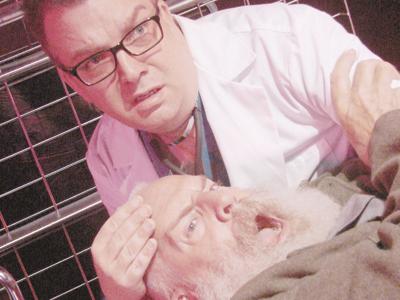

As part of Pacific Repertory Theatre’s 27th annual Shakespeare Festival, they’re following up one of the playwright’s greatest comedies with one of his greatest tragedies.
Twelfth Night, the comedy of mistaken identity, finished last weekend. Next up is the profound King Lear. It’s a risky move.
“The big dramas are often very hard to attract audiences to,” says PacRep founder Stephen Moorer. “Even brilliant and compelling masterworks like King Lear.”
The play tells the story of the loyalties and betrayals of an arrogant patriarch by his three daughters. PacRep’s synopsis, borrowed from the Sydney Theatre’s production starring Geoffrey Rush, gets to the heart of the story:
“A man in decline. Yet, as his mind falters, he attains new wisdom. As people betray him, he discovers true loyalty. At his lowest ebb, he is at his best.”
Actor Julian Lopez-Morillas will wear the heavy crown.
“He’s the real deal,” Moorer says of Lopez-Morillas. The actor has played the role three times, in larger outdoor venues.
“I’m hoping the Circle Theatre space will [let me] play with more subtlety and emotional truth,” Lopez-Morillas says.
He’s prepared for the role by talking with psychiatrists about dementia, and tapping universal feelings of rejection. And he’s older now – 69. The last time he played the role was 25 years ago.
There have been interpretations that call upon myth, religion, history, symbolism. But Lopez-Morillas says he will rely on the playwright.
“I’ve done a great deal of Shakespeare and I always start with the language. Most of what you need is there.”
Director Kenneth Kelleher has moved the setting out of ancient, mythical England and into a modern hospital ward. The winter storm – a key device – remains, by way of the sound and lighting. The cast numbers about 10, and the play runs almost three hours.
“[Audiences] should be prepared for an intense and harrowing experience,” Lopez-Morillas says. “I think of Lear as maybe the greatest play ever written. It fell into disfavor for hundreds of years [but] came into its own in the 20th century, a rough century of conflict and cruelty. It’s not a light evening at the theater.”
Is this the right climate for that? Maybe people are hungry for lighter fare. But maybe we’ve all been lowered into dark undercurrents that can give illumination to a dark work, a work that contains big rewards in the depths.
(0) comments
Welcome to the discussion.
Log In
Keep it Clean. Please avoid obscene, vulgar, lewd, racist or sexually-oriented language.
PLEASE TURN OFF YOUR CAPS LOCK.
Don't Threaten. Threats of harming another person will not be tolerated.
Be Truthful. Don't knowingly lie about anyone or anything.
Be Nice. No racism, sexism or any sort of -ism that is degrading to another person.
Be Proactive. Use the 'Report' link on each comment to let us know of abusive posts.
Share with Us. We'd love to hear eyewitness accounts, the history behind an article.