
People who live in Salinas and are versed in the history of Chinatown know what the six-block community may look like to outsiders, where shelters and food programs run out of Victory Mission Church or Dorothy’s Place. But it used to be an immigrant community, populated by Chinese, Japanese and Filipino migrant workers who worked on the nearby railroads and agricultural fields.
Enter: Moon Gate Plaza, a multi-use housing project trying to revive that history. The project was spearheaded by the nonprofit developer MidPen, which envisioned Moon Gate Plaza as more than just a low-income housing project. “We came forward with a vision to use the ground floor for arts and culture and try to bring life and history back into the neighborhood,” says Betsy Wilson, the project manager.
Wilson explains traditional anchor businesses, like a brewery or restaurant, would be hard to attract even with a new façade. “You’re not going to get traditional retail in this neighborhood,” she says.
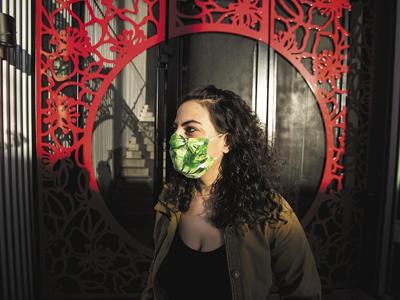
Their approach needed to be different. So they recruited artists and historians to weave history into the project. MidPen circulated a request for proposals in 2018 and landed on Nada Abdelshahid, who grew up in Salinas and was graduating from CSU Monterey Bay’s visual and public art program. Abdelshahid proposed sculptural gates at the two entrances of the plaza, incorporating elements of Chinese and Filipino history. “This was the biggest project I had ever done,” she says.
They also brought on JC Gonzales, founder of Urban Arts Collective, a Salinas resident and former fieldworker. At the time, Gonzales had just finished an installation called Convergence, which focused on women in agriculture, at the Steinbeck Center. He was commissioned to create a mural inspired by Convergence. “I used a lot of butterflies. They represent transformation and they don’t know any division,” he says. “I think this mural is going to have a lot of meaning for everyone who lives here.”
In his work and his identity, Gonzales represents the Salinas of today, which is now majority Latino. Abdelshahid, however, had her work cut out for her in researching, and navigating a constant flow of feedback from architects and historians. “What I first proposed was so big and so complicated,” she says. “I had to listen to what was realistic. What we ended up with is simple but powerful.”
One of those guiding voices was Asian Cultural Experience member Larry Hirahara. “What we attempted to do with the architecture is preserve the history of the neighborhood,” he says, explaining the importance of preserving the identity of Chinatown as a place not only for Asian migrant workers but for all laborers.
“The projects, the history, the artists – what we’re telling is an immigrant story,” Hirahara says.
(0) comments
Welcome to the discussion.
Log In
Keep it Clean. Please avoid obscene, vulgar, lewd, racist or sexually-oriented language.
PLEASE TURN OFF YOUR CAPS LOCK.
Don't Threaten. Threats of harming another person will not be tolerated.
Be Truthful. Don't knowingly lie about anyone or anything.
Be Nice. No racism, sexism or any sort of -ism that is degrading to another person.
Be Proactive. Use the 'Report' link on each comment to let us know of abusive posts.
Share with Us. We'd love to hear eyewitness accounts, the history behind an article.