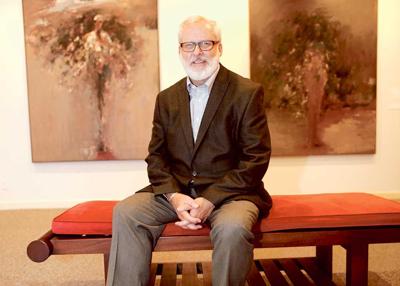

Stuart Allan Chase loves nature, the outdoors, intellectual stimulation, books, skiing, kayaking and gardening. He’ll have to drive a bit for the skiing, but otherwise he might like it here. Culminating a nine-month national search, on April 24 Chase began his new job as the executive director of the Monterey Museum of Art.
The first time he visited Monterey was when he interviewed for the job. He and his wife, Julie – who’s worked in banking and art collections, and with whom he has a 26-year-old daughter in Southern California – have moved around a lot.
Born in 1958, a product of the East Coast, Chase describes himself as an explorer. His resume backs that up. He’s worked at the Berkshire Museum in Pittsfield, Massachusetts; the Rockwell Museum of Western Art in Corning, New York; the Museum of the Southwest in Midland, Texas; the Sterling and Francine Clark Institute in Williamstown, Massachusetts.
“Museum professionals are of two types,” he says. “Lifetime terms, and those that bring creativity and change. I’ve worked five to 13 years in these positions. I am someone who likes to reinvent and reinvigorate museums… and create fresh new outlooks.”
Most recently he was the president and CEO of the HistoryMiami Museum. The city had housed the public library, history center and art museum in a multi-building complex built by architect Philip Johnson in 1984 (the year TV show Miami Vice began airing). When the museum moved out, Chase filled the void with new additions to HistoryMiami, including a changing gallery, a permanent gallery, and a center for folk art and documentary photography.
But the Monterey Museum of Art is a different proposition. They are in possession of two separate buildings, which splits the focus instead of consolidating it, and consumes more resources instead of generating them. In the past, Chase led capital campaigns to improve or expand existing institutions; MMA’s board might like to contract instead.
“I’m still catching up and learning [about that],” he says. “An organization of [this] size and budget is really stressed by managing two distant sites. One has local foot traffic, the other you access by car. One is more urban, the other suburban.”
Chase’s read on the MMA board’s hopes for him: improved collections and facilities, more reflection of Monterey and the region, more inclusion of contemporary working artists.
MMA’s president of the board, Ronda Eubanks, distills it further.
“We would really like the museum to have a larger presence in the community,” she says. “Stuart’s a creative guy. He can think of different ways to get people to come into the museum.”
When asked if a director’s job is to carry out the board’s wishes or to lead the board, Chase doesn’t take the bait.
“There is a medium. The board has retained me to help guide the museum’s relationship with the community, fiduciary responsibility, code of ethics. It’s a team, a relationship, a partnership.”
In that spirit, he’s meeting with community members like Monterey’s city manager, the Monterey Peninsula Chamber of Commerce, the Monterey County Convention & Visitors Bureau and various foundations. He recently went to a meeting in Pacific Grove of the Fund for Homeless Women, which is connected to the What We See homeless women’s photography exhibit still showing at MMA-Pacific.
“It was a warm, interesting conversation,” Chase says. “Lifting the spirit and souls of homeless women. I applaud that sort of programming. That’s a fresh, innovative way to look at museums.”
Brooks Manbeck, MMA’s preparator and exhibition and collection specialist, was at that meeting. Staff members like him and the board can provide Chase with context and history. Manbeck says the previous director, Charlotte Eyerman, favored a more compartmentalized management style in which everyone worked independently in their own silos. That went away after she left.
“Everyone got to know each other a lot better,” Manbeck says. “The board president [Ronda Eubanks] and vice president [Kim Negri]… learned a lot about how a museum operates.”
He and the staff wanted to give Chase a running start in building a broader audience, so they got board approval to put together Who Shot Monterey Pop! Photographs from the 1967 Music Festival for the 50th anniversary of the Monterey International Pop Festival.
They compiled photographs from seven of the photographers who were there, accompanied by text describing the photos, augmented with audio interviews of their stories. The museum will open Monterey Pop on June 2, and convene a panel of all the photographers on June 15, the day before the 50th anniversary concert at the fairgrounds. This is tapping into existing synergy and opportunity.
Manbeck says that two strong staffers have recently left, and that the others (including himself) don’t have a lot of longevity yet, but they are all harkened by Chase’s openness in conversation.
Eubanks says, “[Stuart] is super positive, pleasant, easy to work with, enthusiastic, a great listener.”
Chase distills it this way: “I lead with exuberance.”
(0) comments
Welcome to the discussion.
Log In
Keep it Clean. Please avoid obscene, vulgar, lewd, racist or sexually-oriented language.
PLEASE TURN OFF YOUR CAPS LOCK.
Don't Threaten. Threats of harming another person will not be tolerated.
Be Truthful. Don't knowingly lie about anyone or anything.
Be Nice. No racism, sexism or any sort of -ism that is degrading to another person.
Be Proactive. Use the 'Report' link on each comment to let us know of abusive posts.
Share with Us. We'd love to hear eyewitness accounts, the history behind an article.