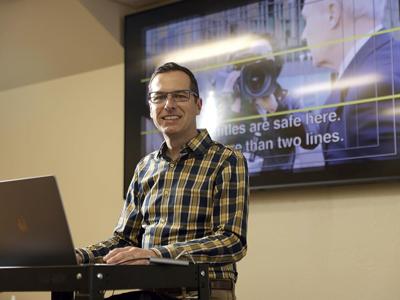

No one grows up thinking: I want to write subtitles for a living. Yet, “video content creation is skyrocketing,” says Max Troyer, an associate professor at Middlebury Institute of International Studies in Monterey, where he teaches an audiovisual localization course – part of the two-year Translation and Localization Management master’s degree.
The world is all about a new type of video, vertical and subtitled, designed for YouTube, Instagram and TikTok. People scroll on their phones and expect to understand without the volume on, Troyer explains, adding that making subtitles is now simply part of producing video content and part of the contemporary social media experience.
“Any video that appears on social media has to be subtitled,” Troyer says. That means there are jobs to be had.
“Historically, the Netflix localization team has about 80 people spread on two campuses, L.A. and Los Gatos, and roughly a dozen of those are TLM graduates,” Troyer says of the streaming juggernaut that, with its public subtitling guidelines, became a lingua franca of the industry. “We are not taking over yet, but we have a good representation,” he adds.
The Middlebury Institute is also making one course, “Subtitling for Streaming: Learn the Industry Standards,” available to the wider community.
“It’s completely asynchronous,” Troyer says of the course. “You sign up and get access to all course materials. All my lecture content is converted into short videos. It takes three to five hours to get through the primary learning material, but there’s optional material for further study that can take you into rabbit holes of stuff that you can unpack and keep learning.”
Who is the course good for? Translators who want to offer another service, Troyer says. They would be able to translate videos for their clients, along with the subtitles. It could also be useful for video content creators.
“Video crafting is not that hard to learn,” Troyer says, “but then the videomaker has to hire someone to do subtitles.”
One principle from the world of subtitling that might not be immediately visible (or audible) to viewers: “When we subtitle, we assume that people can hear,” Troyers says. “When we do closed captions, we assume people can’t hear. That’s the fundamental thing.”
(0) comments
Welcome to the discussion.
Log In
Keep it Clean. Please avoid obscene, vulgar, lewd, racist or sexually-oriented language.
PLEASE TURN OFF YOUR CAPS LOCK.
Don't Threaten. Threats of harming another person will not be tolerated.
Be Truthful. Don't knowingly lie about anyone or anything.
Be Nice. No racism, sexism or any sort of -ism that is degrading to another person.
Be Proactive. Use the 'Report' link on each comment to let us know of abusive posts.
Share with Us. We'd love to hear eyewitness accounts, the history behind an article.