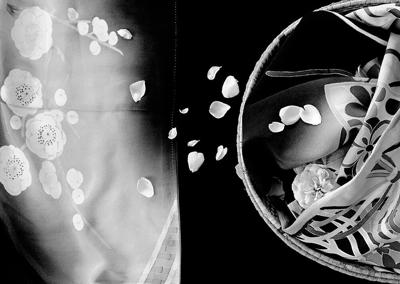

Technically speaking, local photographer Jerry Takigawa has been photographing for 50 years, but doesn’t count the first 10 years. “What’s the phrase? You have to put in your first 10,000 hours?” he says.
However he calculates his career in his mind, he’s been an award-winning photographer since the 1980s including receiving the Imogen Cunningham Award in 1982 and the Clarence J. Laughlin Award in 2017. His photographs have circulated through galleries and publications globally, including Griffin Museum of Photography in Boston, LensCulture and South Korea’s Chaeg Magazine.
Center for Photographic Art, the Carmel-based nonprofit that advocates for the continued craft of film photography, puts Takigawa’s 40 years’ worth of work on display in an exhibit titled Liminal Language.
Behind the title, Takigawa says he worked closely with curator Helaine Glick to find the common threads of his work since his 1980 Kimono series to his more current collections such as False Food and Balancing Cultures. The exhibit is about showing his resume in its entirety. “We realize that my journey as a photographer may be a developing language,” he says. “A language that would express things that were important.”
Just as a musician has music and a painter has paint, Takigawa explains, “photography is my language.” And what makes up this language? It depends – on the era, on what he’s interested in, on if he was more retrospective, present or forward-thinking.
His Kimono series is incredibly personal. Made up of color film pieces, photos that would otherwise be a landscape or cityscape are cut or obscured with silk kimonos or parasols. The fabrics break up the uniformity, with some billowing in the wind, or sometimes held up by a feminine hand or figure, as to fit into the landscape behind it like a puzzle piece.
Takigawa’s parents were born in Japan and immigrated to the United States. Their timing meant that they had to suffer through internment during World War II. “My parents wanted me to be American, understandably because of being in those camps,” he says. “So for a long time, I ignored that part of myself.” The Kimono series was his first exploration of that identity. In that case, his photos feel retrospective.
But in 2014, he was moved by a global conversation and created False Food. Inspired by a Monterey Bay Aquarium volunteer’s talk, Takigawa learned how plastic pollution in the ocean makes its way up the food chain. Working in his signature photo-collage style, the series makes use of mostly black-and-white photographs overlaid with found pieces of plastic.
Elements of each series can be found in his new show. As for what’s next, Takigawa doesn’t know yet. “The sort of language I use is evolving all the time,” he says.
(0) comments
Welcome to the discussion.
Log In
Keep it Clean. Please avoid obscene, vulgar, lewd, racist or sexually-oriented language.
PLEASE TURN OFF YOUR CAPS LOCK.
Don't Threaten. Threats of harming another person will not be tolerated.
Be Truthful. Don't knowingly lie about anyone or anything.
Be Nice. No racism, sexism or any sort of -ism that is degrading to another person.
Be Proactive. Use the 'Report' link on each comment to let us know of abusive posts.
Share with Us. We'd love to hear eyewitness accounts, the history behind an article.