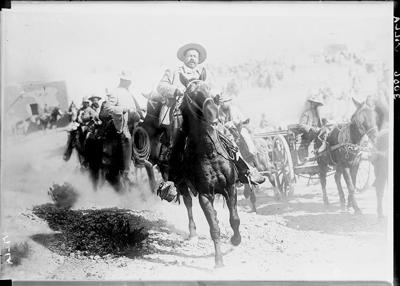

PBS calls its 2013 documentary series Latino Americans: The 500-Year Legacy That Shaped a Nation a “landmark,” a six-hour chronicle of the 50 million Latinos in the U.S., covering the time before European colonization of the Americas to the Wild West to right now.
It’s a monumental work that deserves attention, and it’s getting it.
CSU Monterey Bay professors Maria Villasenor and Mercedes Maciel, with support from Amalia Mesa-Bains, have spun it into a year-long series of screenings paired with performances, panels and workshops at Cesar Chavez Library in Salinas and on campus, funded by the National Endowment for the Humanities and the American Library Association.
“The idea was to take this PBS series into the community,” Mesa-Bains says.
It began last October, with a screening of the episode “The New Latinos” at CSUMB’s Music Hall. The second installment, in November, featured a lecture by playwright Luis Valdez. The third part comes this Tuesday, with a screening of the episode called “Prejudice and Pride,” opening with a poetry reading by CSUMB creative writing professor Diana Garcia, author of the poetry collection When Living Was a Labor Camp.
That book draws from her life as the child of farm workers in the San Joaquin Valley and her experiences as a single mother on welfare, and went on to win the Before Columbus Foundation’s American Book Award.
On Tuesday, Garcia will read, among others, a poem from an unpublished suite of poems she’ll present on March 8 at the Smithsonian’s National Portrait Gallery honoring Dolores Huerta and the 50th anniversary of the UFW. Also reading there: U.S. poet laureate Juan Felipe Herrera, who visited CSUMB last year.
“It’s an honor for us to get a preview,” Villasenor says. Here is an excerpt from Garcia’s forthcoming poem “Huelga”:
“The word ‘Huelga’ feels heavy. Think/ of what this word means to those who/ follow you out that day. Think of the lives/ changed from this one word, workers daring/ to claim their lives, daring to think their arms,/ backs, legs should earn them more than/ subsistence wages, more than a quick bite/ mid-day, more than those furtive trips to/ the edge of the fields, hunkered down/ against prying eyes.”
Garcia says, “Mexico stretched up into California and into Arizona and Texas, leaving an imprint that remains to this day.” That imprint will only expand.
(0) comments
Welcome to the discussion.
Log In
Keep it Clean. Please avoid obscene, vulgar, lewd, racist or sexually-oriented language.
PLEASE TURN OFF YOUR CAPS LOCK.
Don't Threaten. Threats of harming another person will not be tolerated.
Be Truthful. Don't knowingly lie about anyone or anything.
Be Nice. No racism, sexism or any sort of -ism that is degrading to another person.
Be Proactive. Use the 'Report' link on each comment to let us know of abusive posts.
Share with Us. We'd love to hear eyewitness accounts, the history behind an article.