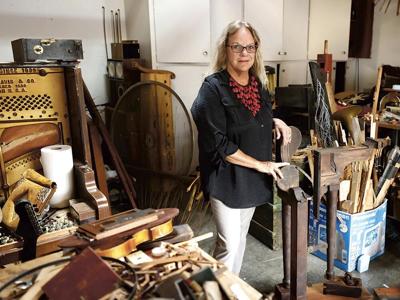

One shouldn’t immediately see that it was once a piano. Or at least artist Nancy Sevier hopes that approaching her art is “a matter of discovery.”
“Then you start to see more,” Sevier says, commenting on one of her pieces, “Reprise,” which is made out of parts of an old piano and shares a name with an exhibit that opened at the Monterey Museum of Art on Aug. 5.
“Not many people necessarily know how music instruments look inside,” she says about the same piece. “You find whatever you want to see.”
It’s the second time that Sevier has used music as an inspiration for her shows, seeing it as a universally transformative experience, shared by most humans. She grew up with music and played flute as a child, but doesn’t practice any instrument at the moment, she says. Instead, after years in darkrooms developing photos or pursuing sculpture, she found herself becoming a sort of a musical dumpster diver.
“I love objects and I’m interested in the meaning objects hold,” says Sevier, who was born in Southern California and is based in Salinas.
It started with a pile of old instruments found on the streets of San Jose. Then people started telling her: “‘There is a piano on such a street,’ and I would go there to see what’s there,” she says. “There are a lot of people who are trying to get rid of a piano these days. It seems that people play less.” One of her earliest pieces conceived this way combined an old violin case with an image of a dead bird.
The new exhibit is a fusion of abandoned parts given a new life: player pianos, guitar strings and organ wires become the materials of work.
“Some people are dismayed that I take instruments apart,” Sevier says. “But when I found them, some of them had rats in them… ” And so, like Doctor Tulp from Rembrandt’s masterpiece, Sevier slices her dead victims with great curiosity, examining the veins, bellies and hair of instruments for the sake of humanity.
While the pieces in the new exhibit are mostly sculptures – three are standing forms – Sevier has an extensive background in photography, too.
Sevier says she hopes people “will feel rewarded if they decide to spend a bit of time in front of each piece” in the show. “There’s history there,” she says.
(0) comments
Welcome to the discussion.
Log In
Keep it Clean. Please avoid obscene, vulgar, lewd, racist or sexually-oriented language.
PLEASE TURN OFF YOUR CAPS LOCK.
Don't Threaten. Threats of harming another person will not be tolerated.
Be Truthful. Don't knowingly lie about anyone or anything.
Be Nice. No racism, sexism or any sort of -ism that is degrading to another person.
Be Proactive. Use the 'Report' link on each comment to let us know of abusive posts.
Share with Us. We'd love to hear eyewitness accounts, the history behind an article.