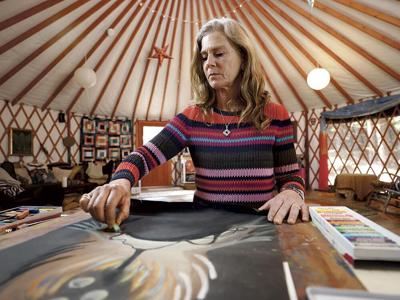

Sometimes, words fail. Writers aren’t generally in the business of admitting this but it’s true – there are things that cannot, or cannot adequately, be described in words.
Luckily, for times like these, there are other forms of self-expression. Jennifer Allen has seen it happen again and again – she’s a licensed art therapist who helps people use visual art to express themselves and heal from trauma.
The American Art Therapy Association defines art therapy as “a mental health profession that uses the creative process of art-making to improve and enhance physical, mental and emotional well-being.” Allen sums it up more simply – art therapy is a way of using non-verbal communication to take what’s inside and move it outside. It can be an especially natural fit for children, but all kinds of people at all ages can benefit from art therapy.
No, you don’t need to be a natural artist. Here’s how it works: Allen and a client sit down at a table with paper, pencils, pastels, etc. on it. Allen begins with a check-in – what brings you to therapy? At this point the client may have something they want to explore, and they may not. Either way, Allen asks a series of questions: What does that thought feel like? And is there a color or texture or shape that goes with that feeling? From here, the client begins to doodle.
Once complete, Allen asks her client to take a careful look at what they’ve drawn – turning it upside down and sideways – and to write down the first three words or phrases that come to mind. Next she asks the client to pick a part of the drawing that speaks to them – that blue line, for instance, or yellow circle – and speak from that perspective. How does that yellow circle feel about its place on the page, in relation to the rest of the doodle? This communication via metaphor, Allen says, helps to keep our intellectual defense mechanisms from engaging right away.
This might sound woo-woo. But Allen swears by what you can discover using the creative right brain instead of the analytical left brain. “I fully trust the creative process,” she says. “It never fails.”
Finally, Allen says clients can take a picture of their creations and keep them somewhere they’ll see it – the lock screen of a phone, for example – to be reminded of the process.
Maybe it’s not that words fail. Maybe, sometimes, they just aren’t exactly the right tool for the job.
(0) comments
Welcome to the discussion.
Log In
Keep it Clean. Please avoid obscene, vulgar, lewd, racist or sexually-oriented language.
PLEASE TURN OFF YOUR CAPS LOCK.
Don't Threaten. Threats of harming another person will not be tolerated.
Be Truthful. Don't knowingly lie about anyone or anything.
Be Nice. No racism, sexism or any sort of -ism that is degrading to another person.
Be Proactive. Use the 'Report' link on each comment to let us know of abusive posts.
Share with Us. We'd love to hear eyewitness accounts, the history behind an article.