
OK, let’s just get it out of the way, because it probably appears prominently in many people’s minds when they hear the name “Cheech.” Richard Anthony “Cheech” Marin was (and, recently – sometimes – is again) one-half of the comedy duo Cheech & Chong, from the ’70s and early ’80s. Their hazy slapstick movies were cult favorites of subversive drug comedy/goofy hijinx, like driving a van made of marijuana across the U.S./Mexico border while smoking a spliff the size of a Pepsi can and harassing nuns in the next vehicle.
Pineapple Express and the Harold & Kumar movies are the series’ grandchildren. But from his homebase in Malibu, where his family’s lived for three generations (“Some people came to this country under chains,” he says in his warm Mexican-East L.A. accent, “mine came under chain links”), Cheech seems ambivalent about that iconic stoner role.
“There’s a whole generation that doesn’t know what Cheech & Chong is,” he says. “It’s not so much the overarching aspect of my career. I’ve done a lot of things since then.”
And that’s the truth. He’s had the career of four people. In addition to the comedy albums and movies with off-and-on counterpoint Tommy Chong, he’s done movies like Born in East L.A. and Tin Cup (from whence he picked up a love of golf); recurring television characters on Nash Bridges, Judging Amy and Lost; film work with Robert Rodriguez, including the Spy Kids trilogy, From Dusk Till Dawn and the awesome and over-the-top Machete; starring, supporting and cameo roles in a whole mess of indie films; and Disney voiceover roles in The Lion King and Cars 2.
That’s the celebrity Cheech. Then there’s the art collector Cheech, who we will see this Saturday at Museum of Monterey, where he will appear accompanying artwork from 26 artists in his vast collection – said to be one of the largest Chicano art collections in the country.
Inspired to study liturgical works of the Catholic church and the Renaissance, he says, “I got into art very early – 10 or 12 years old. I would go to the library and read about who did what, artists, movements.”
“I discovered Chicano artists,” he says in a Museum of Monterey video profile. “Well, they were already there. Like America – I happened upon them… I recognized them as great painters.” But he says Chicano artists were grossly ignored in the contemporary art world, and he perceived that as an opportunity.
“It was the perfect storm,” he says. “I had the art knowledge and the money. When I started collecting, all the masterpieces of Chicano art were out there, available. Certainly no museum had a collection. I embarked on a journey to use my celebrity to promote [these artists], to be the face of Chicano art.”
It’s worked ridiculously well. From 2001-07 he took his collection Chicano Visions: American Painters on the Verge on a truly unprecedented tour to 12 cities, including a stop at the Smithsonian that drew 970,000, Cheech says. He’s toured several variations of his collection, of which the Museum of Monterey’s exhibit, Chicanitas: Little Paintings from the Collection of Cheech Marin, is one of the newest.
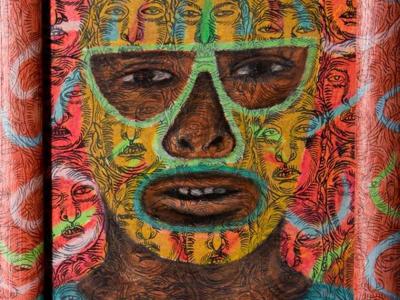
It’s made up of small works, 16x16 inches or smaller, ranging from photo-realism to abstract portraits to landscapes, from established and emerging Chicano artists, presented with accompanying artist bios.
Though Cheech is reluctant to favor any one of these – they’re like his children – he savors many elements of “To Press II,” a sultry scene in which a woman in high heels and not much else straddles an ironing board while ironing. It’s by San Francisco artist Ana Teresa Fernandez.
“It’s provocative,” he says, “well painted, mysterious. It’s part of a series about women and society, work and sexuality. It encompasses all that and they’re sexy. Good technique… Chicano painters never gave up the brush, didn’t go into every ‘ism.’ It’s handcrafted, from the Mexican art tradition.”
When asked about what it means to be Chicano, Cheech takes the side of referee instead of contender: “It began in the late ’60s, with the political, then it got personal. That’s what’s so great about it. Every generation gets to define it and owes nothing to the previous generation.”
He says shows like this are important because they expose people to the “conversation” of art, introduce the viewer to Chicano artists, and help define a Chicano experience that, he predicts, will help define this country in the future.
CHICANITAS: LITTLE PAINTINGS FROM THE COLLECTION OF CHEECH MARIN opens Saturday 4-5pm with a members walk-through, 5-7pm with a public reception ($10), and runs to April 2012, at Museum of Monterey, 5 Custom House Plaza, Monterey. www.museumofmonterey.org
(0) comments
Welcome to the discussion.
Log In
Keep it Clean. Please avoid obscene, vulgar, lewd, racist or sexually-oriented language.
PLEASE TURN OFF YOUR CAPS LOCK.
Don't Threaten. Threats of harming another person will not be tolerated.
Be Truthful. Don't knowingly lie about anyone or anything.
Be Nice. No racism, sexism or any sort of -ism that is degrading to another person.
Be Proactive. Use the 'Report' link on each comment to let us know of abusive posts.
Share with Us. We'd love to hear eyewitness accounts, the history behind an article.