
Photographer and gallery owner Carol Henry curated the Center for Photographic Art’s upcoming all-women photography show, She Loves Me, She Loves Me Not.
She explains in an email: “Carmel’s long history as a photographic epicenter has primarily focused on the work of renowned men through the ‘West Coast tradition.’ I chose to curate this exhibition because it needed to happen.”
She wanted to recognize women who flipped the paradigm. So these are images of men, taken by women: “[It] takes us away from the usual photo perspective of men looking at women,” Henry continues.
Included in the exhibit: Imogen Cunningham, who was called an “immoral woman” for exhibiting nude fine art photographs of her own husband. Henry put two of those images in this exhibition.
The show is comprised of a dozen women, multiple photographs from each, in an unpredictable variety of styles – from fine art composition to documentary to journalistic. There are arty images like Edna Bullock’s “David,” of men draped naked across textured landscapes. There is starkly real stuff like Jodi Cobb’s “Subway Santas,” a color photo of beleagured mall Santas huddled together on a New York City subway platform.
Flor Garduno – a Mexican photographer whose work is in the permanent collections of New York’s Museum of Modern Art and the National Library of Paris – is in the show. So is Cobb, one of the only female photographers on staff at National Geographic, which led her to traveling to and photographing in 65 countries in her career.
There is a catalog for the show that expounds on the women’s roles in the photography world, like this bit on Guggenheim-winning photojournalist and documentarian Mary Ellen Mark, whose photo of a haggard Marlon Brando is in the show: “A fearless approach to reality informs her work, whether photographing her own in-depth studies or on assignment for movie studios.”
Henry says these women’s works are highly sought after for exhibitions.
The title of the show seems to suggest that the rumination comes from the mind of a man, considering the love of a woman. But Henry says it’s in recognition that some of the photos depict subjects the photographer shares a relationship with – lovers, husbands, family – while others focus on environmental studies or journalistic aspects.
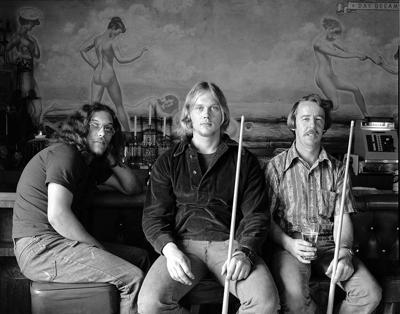
That includes Judy Dater’s “Daydreams” from 1973. Three men sitting at a bar, two of them with pool sticks in hand, look directly at the camera with starkly different expressions, while a big mural of naked and nubile women frolicking on the beach hovers above them.
Edna didn’t pick up a camera until her photographer husband Wynn passed away.
Dater told Henry the picture was taken in a roadhouse in Sonoma, complete with a madam. Henry interprets it this way: “This image is a time capsule of the ’70s when life seemed less complicated and there was a liberated feeling circulating through the culture.”
But maybe it can be seen in another light. Shooting pool and drinking in the daytime is not an example of the most exalted activity, and the men don’t look like the type who would be welcomed to join the women depicted in the mural. Is this a picture of liberation, reality, vulnerability or delusion? And what about that title? “Daydreams.”
At the least its vagueness suggests less a definitive statement and more of a conversation.
Speaking of which, there will be a panel before the opening this Saturday, Jan. 7, moderated by local poet Patrice Vecchione and composed of Carol Henry; Martha Casanave, who’s been on the Peninsula scene since the 1970s; Dixie Dixon, daughter-in-law of Dorothea Lange; Barbara Bullock, who will talk about how her mother Edna, who is included in the show, didn’t pick up a camera until her photographer husband Wynn passed away; and Judy Dater, coming in from Berkeley.
On Tuesday, Jan. 10, Cunningham’s granddaughter Meg Partridge will speak and show her Oscar-nominated film Portrait of Imogen at CPA.
2016 was looking like the Year of the Woman in politics and in power. That was before Hillary Clinton’s upset loss, South Korean President Park Geun-hye’s impeachment, speculation about Ruth Bader Ginsburg’s tenure on the Supreme Court, and Gwen Ifill’s passing. Henry thought we would be celebrating the election of our first woman president by now, which she says would have been a profound launch for the show.
“I was wrong. I think we just drew the ‘Do not pass Go. Do not collect $200’ card from Community Chest. I now feel this exhibition moves from celebration to assuagement.”
But Henry adds this show is also put together to celebrate and inspire the kind of “tenacious, determined, groundbreaking” spirit these 12 photographers showed throughout the century in which they collectively worked. If that’s the case, maybe it’s just the beginning of a movement that leads to a profound achievement, like electing our first woman president, in 2020.
(0) comments
Welcome to the discussion.
Log In
Keep it Clean. Please avoid obscene, vulgar, lewd, racist or sexually-oriented language.
PLEASE TURN OFF YOUR CAPS LOCK.
Don't Threaten. Threats of harming another person will not be tolerated.
Be Truthful. Don't knowingly lie about anyone or anything.
Be Nice. No racism, sexism or any sort of -ism that is degrading to another person.
Be Proactive. Use the 'Report' link on each comment to let us know of abusive posts.
Share with Us. We'd love to hear eyewitness accounts, the history behind an article.