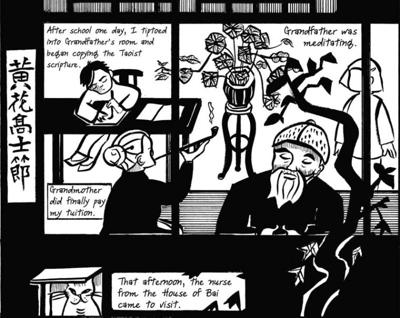

Author and artist Belle Yang’s storybooks are drawn in a Chinese folk art style that’s expressionistic and deceptively childlike. Her latest work uses that foundation as a springboard to reach higher and plumb deeper than anything she’s done yet.
Published by W.W. Norton & Company and released this month, Forget Sorrow: An Ancestral Tale signals Yang’s first foray into the arena of graphic novels, and is being received as a major work of memoir, history and culture that friend and fellow author Amy Tan calls “nearly mythic.”
Yang, who’s lived in Asia but currently makes her home in Carmel, says it’s been brewing for 14 years, and though she had read and been exposed to manga – serial Asian comics – it wasn’t until her editor, Alane Salierno Mason, suggested she explore the graphic novel medium, that she started to study award-winning works like Maus by Art Spiegelman, Persepolis by Marjane Satrapi and Fun Home by Alison Bechdel.
She took to the medium naturally. Forget Sorrow (the translation of her Chinese name, Xuan), is an epic story, relayed to her by her father Zu-Wu, whom Yang refers to as Baba, of the Yang family in Manchurian China – most acutely, his observations of his own father, three uncles and powerful, patriarchal grandfather. It follows the storyline of Shakespeare’s King Lear, moving methodically, nimbly, across the days, months and years of the family’s evolution, as well as China’s.
The preamble lays speedy background (much of it tumultuous, including a harrowing stalking incident), segueing to her father’s story, which flashbacks to his boyhood in post-World War II China. In 1943, American planes bombed the Japanese-occupied areas of Manchuria, compelling the four brothers of the Yang family to reunite in Xinmin at the house of their patriarch father, Zu-Wu’s grandfather. There, Zu-Wu has a front-row seat to nearly the entire clan as they navigate their way through relationships, status, family piety, comedy and treachery (family stuff), while fending off bandits, Japanese, communists and nationalists.
There are no chapters, but there are transitional scenes that break from the past and continue, on a parallel track, in the present in which Yang’s father is telling her the story. One transition leaves Yang’s great-grandfather and great-grandmother in their grief after burying a daughter, and revisits Yang’s parents’ home as her father finishes that segment of the story. Later that night, Yang is pictured in her own room, pen and notebook in hand.
“I couldn’t sleep,” reads the caption. “I scribbled down Baba’s story.”
A cat named Chairman Mao discreetly accompanies many of the panels, both in the past and the present, linking the generations across their storylines. Young Zu-Wu also necessarily occupies many frames, ever observant, lending the story a historian’s attention to detail.
Yang hands the reigns of the narrative almost wholly to her father (in her blog on redroom.com she refers to Forget Sorrow as “… my (our) book… ”), his words channeled through her lyrical brushwork in deep, black gouache and pigment markers, painted like calligraphy. It’s a family endeavor, not unlike her previous illustrated book about her father, Odyssey of a Manchurian. Forget Sorrow is bigger, nearly epic in scope, though still personal in detail. Those immersive details – the landscape and fauna, clothes, furniture, architecture, mannerisms – Yang spun from the oral histories she’s heard and from her own sojourns to China. Some tree leaves are drawn as clumps of triangles. Shading is done with hatching. A rising sun shoots beams into the sky; hills and crops flow like they’re gripped by eddies of wind. There’s a drawing of poplars, willows and cypresses that are merely suggestive, in a cubist idiom. These drawings are constructed like perspective-free puzzles in a style that author Maxine Hong Kingston compares to Marc Chagall’s.
Yang employs the cinematic breadth of the graphic novel form. She folds the story back into itself when she draws herself writing, and her father critiquing, the first manuscript of the book we hold in our hands – like Charlie Kaufman’s inverted narratives. The point of view moves about unrestrained but not without purpose. In panels in which Zu-Wu’s father and second uncle discuss an internal power struggle over family land, the “camera” of Yang’s pen pans wide on shots of kids playing outside; the adults are tucked into the corner of the panel. Many things are happening at once, it implies; what the adults are talking about will affect the unwary children Yang has focused us on.
It’s an example of the kind of creative freedom that’s attracted creative types to the form like Joss Whedon (Buffy the Vampire Slayer), editor Robert Weil, and historian Howard Zinn (A People’s History of American Empire, written when he was 85). It’s even been reported that a posthumous graphic novel called Fated is slated to come out in June, conceived by Michael Jackson and co-written by Gotham Chopra, son of Deepak Chopra (who also wrote a graphic novel). This is only the beginning – for graphic novels and for Belle Yang. Her next book will tell the story of her mother’s family.
(0) comments
Welcome to the discussion.
Log In
Keep it Clean. Please avoid obscene, vulgar, lewd, racist or sexually-oriented language.
PLEASE TURN OFF YOUR CAPS LOCK.
Don't Threaten. Threats of harming another person will not be tolerated.
Be Truthful. Don't knowingly lie about anyone or anything.
Be Nice. No racism, sexism or any sort of -ism that is degrading to another person.
Be Proactive. Use the 'Report' link on each comment to let us know of abusive posts.
Share with Us. We'd love to hear eyewitness accounts, the history behind an article.