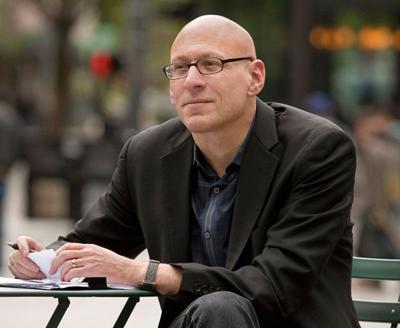

If you believe the hype, David Shields is on the war path against the novel as a relic that should be trampled in the velocity of modern life. He’s a brainiac reconstructing the template of the genre. A cynic feeding the more nihilistic impulses of the intellectual and literary crowd.
If you talk to Shields, now on a cross-country book tour and coming to talk at Monterey Peninsula College on Tuesday, April 9, as part of the school’s Great Books Program, you’ll realize there is some of the usurper in him, but more to the core, he’s a thoughtful guy who loves reading books – and wants to write books differently.
“Kafka says, ‘A book must be the ax for the frozen sea within us.’ I think we live in a very mediated, simulated society,” Shields says from a hotel room in Los Angeles. “In my view, more dreamscape, more fiction… I’m not sure that’s what allows us to break the frozen sea within us. I’m not opposed to the novel, I’m opposed to novels that aren’t very novel.”
He says he loves Moby Dick, A Remembrance of Things Past, The Life and Opinions of Tristram Shandy, Gentleman; he name checks and quotes from masters of literature, art and culture, like Blaise Pascal, Friedrich Nietzsche and David Foster Wallace (“Writing at its best is a bridge across the abyss of existential loneliness”). He even rifles urgently in his hotel room for a book that contains a “beautiful” quote he “loves” from Russian composer Sergei Prokofiev. The quote: “To write only according to the rules laid down by previous classics signifies that one is not a master but a pupil.”
L.A.-born, San Francisco-raised and currently Seattle-based Writer-in-Residence at the University of Washington, Shields has been a voracious reader. As his latest book, How Literature Saved My Life, might suggest, books have been crucial to him.
“I had a really bad stutter and was very much imprisoned,” he says. “I stutter far less now, but it’s still something I have to try to control. At a pretty early age, in this very direct way, I wanted to turn, as in Edmund Wilson, the wound of stuttering and turn it into the bow of art. [Take] the sort of broken language of stuttering and try to redeem it as what I hope is the artful language of my books. Reading and writing has, absolutely, emotionally saved my life.”
The 56-year-old graduated from Brown in ’78 and the University of Iowa Writers’ Workshop in ’80, publishing, concurrently, essays and stories in The Village Voice, Slate, New York Times Magazine, Harper’s, McSweeney’s, and his prolific books, starting with 1984’s not ironically titled Heroes: A Novel, about college basketball. The next book was Dead Languages, another novel, this one about “a boy who stutters, at war with, yet entranced by, language.”
Sounds a lot like Shields, but it is and it isn’t. It blurs fiction and memoir, signaling the beginning of Shields’ mash-up to escape the confines of genre writing and “over-investment in coherence, unity, time, place and action,” turning his books into something he calls “literary collage.” It’s a directional change in the format of the novel that he’s reinforced most notably in 2008’s double memoir/mixed format book The Thing About Life is That One Day You’ll Be Dead, 2010’s multi-dimensional look at truth and reality, Reality Hunger: A Manifesto, and How Literature Saved My Life.
“It’s not a refuge for the compositionally disabled,” Shields says of his writing collage experiments, where poems, quotes, facts, anecdotes, criticism and musings take turns. “I’m interested in work that’s not a plodding narrative, or explains everything over and over. I’m trying to make this a work of literary art; the reader has to follow my lead.”
Critics have been mostly “extremely generous,” Shields says, though journalistic coverage gets whittled down to the dramatic and “soundbite-able” refrain: “David Shields says the novel is dead.” But his message is far more nuanced – he’s experimenting.
“If I feel totally lost, despairing, convinced the work is terrible, that’s a really good sign that I’m actually writing,” he says. “If the work is going smoothly, I’m in trouble… I’m kind of happily confused as I write my books.”
Asked if literature in a dark or despairing mode might imperil a reader psychically or spiritually, and he brightens.
“I think that’s almost exactly what makes literature so exciting,” he says. “If all it could do is save your life, it might be a big yawn. Take this pill and you’ll be OK. That sounds really boring, like something out of Huxley’s Brave New World. All of my favorite books, without exception, are dark, cynical, nihilistic. I think that’s the very excitement of it. My wife likes to go skiing. I’m not a skier. I’ll ask her, ‘Aren’t you afraid of getting hurt?’ [She says] ‘That’s what’s so fun.’ I thought of Flaubert’s line: ‘The value of a work of art can be measured by the harm it’s spoken of.’ I was thinking at one point, of calling [my] book How Literature Ruined My Life.”
He’s been two months into this book tour and has discovered an aggregate of 12-15 questions most asked of him. So what he’s most interested in, paradoxically, is his audiences’ experiences with literature, using his own work and life as a “springboard.” And that sounds a lot like the “Great Conversation” with which MPC’s Great Books Program was born to begin.
DAVID SHIELDS speaks 7pm Tuesday at the Sam Karas Room, Monterey Peninsula College Library, 980 Fremont St., Monterey. Free. www.mpc.edu/greatbooks
(0) comments
Welcome to the discussion.
Log In
Keep it Clean. Please avoid obscene, vulgar, lewd, racist or sexually-oriented language.
PLEASE TURN OFF YOUR CAPS LOCK.
Don't Threaten. Threats of harming another person will not be tolerated.
Be Truthful. Don't knowingly lie about anyone or anything.
Be Nice. No racism, sexism or any sort of -ism that is degrading to another person.
Be Proactive. Use the 'Report' link on each comment to let us know of abusive posts.
Share with Us. We'd love to hear eyewitness accounts, the history behind an article.