
The California Department of Parks and Recreation, per its website, has “the largest and most diverse recreational, natural and cultural heritage holdings of any state agency in the nation.”
That includes 280 state parks, 340 miles of coastline, 970 miles of lake and river frontage, 15,000 campsites, and 4,500 miles of trails. That’s beaches, lighthouses, monuments. There’s a division called Off-Highway Motor Vehicle Recreation for off-road dirt bikes, ATVs, and 4x4 vehicles (“4-wheelin’”… no “g”).
All of this, the state reasons, benefits Californians and preserves natural treasures and historic inheritances.
A bunch of state parks reside in Monterey County, from Andrew Molera State Park in Big Sur to Moss Landing State Beach. The most popular is probably Point Lobos, and the most overlooked might be Pacific House Museum.
It’s an adobe building at Custom House Plaza, part of Monterey State Historic Parks, a collection of 12 adobe buildings and gardens in Old Monterey, like Colton Hall and Stevenson House.
“A lot of locals say they’ve never been inside [Pacific House] before,” says state parks guide (and former Weekly writer) Stuart Thornton. Not for lack of trying on the part of the MSHP. They recommend starting self-guided or guided tours at Pacific House. And it’s free to go in.
“This is a great place to visit if you don’t have a lot of time but you want to learn about Monterey,” state parks interpreter Lisa Bradford says. Maybe locals are too familiar with the Monterey Colonial architectural style buildings for it to stand out as special. But it is.
Pacific House was built in 1847 during the U.S. occupation of California (Monterey was taken from Mexican rule in 1846), and in the intervening years the building’s been munitions storage, a hotel, a courthouse, a tavern, a newspaper office. Since the late 1990s, it’s been a museum.
Inside, there are kiosks that re-create details from the other buildings of the State Historic Park, like a kiosk that tells us that Custom House (built by Mexico) is the oldest government building in the state. In another room there are parts of whale vertebrae and ribs. Another contains two landline phones that recite Rumsien words for “pelican” and “water.” The gardens behind Pacific House once hosted bull and bear fights on Sundays.
There are exhibits that show the colonial era expansion fueled by hunting, trade and shipping, like a stuffed grizzly bear (now bleached white from sunlight).
“The grizzlies would come feed on the whale carcasses after the blubber was flensed off,” Bradford says.
There is an excerpt of writing from Father Antonio de la Ascension of the 1602 Vizcaino Expedition: “This harbour is surrounded with rancherias of Indians, a good-looking affable people, and very ready to part with everything they have… ”
“We look at it gazing back,” Bradford says. “Expansionism was not unusual then – the Dutch, British, Portuguese.”
Upstairs is a room called the Monterey Museum of the American Indian, an exhibition of Plains and Southwest Native American artifacts donated by Zena and Wilford Holman in 1961. It’s organized into areas of warfare, music, pottery, transportation, regalia, children, clothing, textiles, spiritual and basketry.
Period illustrations and paintings, firsthand diary accounts, relics, photos, wall text (lots of wall text, some with braille translations), trinkets and books create an immersive if dated picture of history.
“We have a lot of ideas,” Bradford says, including pop-up exhibits, bilingual wall text, labels upstairs, and a phone app. “We won’t be able to do them all, but some of them will come to fruition.”
One already has: The Pacific House Museum Education Room.
“This was a creepy room,” Bradford says. “It was heavy. Like a tomb.”
MSHP curators wanted a more utilitarian and welcoming space, suited to third – and fourth-graders, and the general public. “We wanted some bright, light images,” Bradford says. “Energy.”
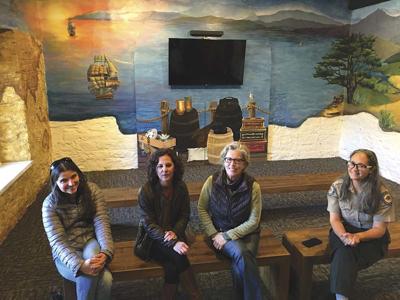
They brought in artists from Open Ground Studios to redo the room with a mural. It took six months. There was more history and research than anyone foresaw, including consultations with local folks like Rumsien Ohlone native and basketweaver Linda Yamane.
“We wanted indigenous people to have space here,” artist Denese Sanders says.
The room used to have a faux banner with a timeline of local, national and world history. It required a lot of reading, so it was taken down and uploaded into two iPads that people can scroll through.
The new mural also works like a timeline, a “wraparound visual story which relays facets of Monterey’s history from prior to 1770, up to 1848.” That story begins with Native Americans, then you “read” the painting left to right.
Painter Kim Campbell says, “Art can be self-explanatory.”
“You walk in and [history] is surrounding you,” says artist Renata Abma.
The colors are done in layers of ocean blue, orange sunlight, green trees and yellow grassland. Craggy adobe brick is exposed, there is storage for extra chairs for lecture audiences, and a plasma TV plays a video about Monterey history.
“[This building] has had so many lives,” Bradford says. “Now it has this beautiful room.”
(0) comments
Welcome to the discussion.
Log In
Keep it Clean. Please avoid obscene, vulgar, lewd, racist or sexually-oriented language.
PLEASE TURN OFF YOUR CAPS LOCK.
Don't Threaten. Threats of harming another person will not be tolerated.
Be Truthful. Don't knowingly lie about anyone or anything.
Be Nice. No racism, sexism or any sort of -ism that is degrading to another person.
Be Proactive. Use the 'Report' link on each comment to let us know of abusive posts.
Share with Us. We'd love to hear eyewitness accounts, the history behind an article.