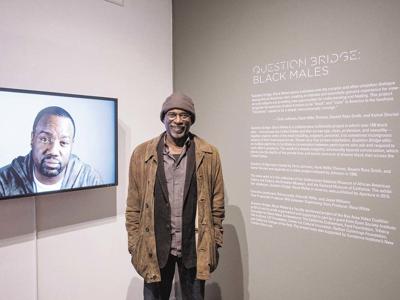

“Art is often considered to be one of those things that can be valuable without being useful.”
That is the opening salvo on the website of Chris Johnson, a photographer and social practice artist who studied with Ansel Adams, Imogen Cunningham and Wynn Bullock. He’s also professor and chair of photography at California College of the Arts, author of The Practical Zone System for Film and Digital Photography, an exhibited artist and curator, and a colleague of photographers Sally Mann, Ted Orland, David Bayles and Martha Casanave.
His photography credentials are exemplary, but it’s a video installation art piece that is earning him recent acclaim. It’s called Question Bridge: Black Males.
It opened at Sundance in 2012, won the 2015 International Center of Photography’s Infinity Award, and is in the permanent collection of the Smithsonian National Museum of African American History and Culture. It’s currently at the Mary Porter Sesnon Gallery at UC Santa Cruz through April 6, and Johnson is speaking at the Center for Photographic Art this Saturday, Feb. 16.
He was born in the Bedford – Stuyvesant neighborhood of Brooklyn in 1948. He says black people were segregated into such enclaves, but when the civil rights movement loosened housing restrictions, black residents who could move to better neighborhoods did so. It created what he calls a “confusing rupture in the community.”
Johnson moved to California in 1967: “A teenager leaving for California to be a flower child,” he says. “From the black ghetto to the mainly white world.”
Fast forward to 2008. One of his former students, Hank Willis Thomas – a conceptual artist of considerable stature – contacted him, asking to collaborate on a project for the Tribeca Film Festival. That would become Question Bridge: Black Males. It’s an update on an earlier version Johnson conceived and created in 1996 for the Museum of Photographic Arts in San Diego.
The format is videos of black males asking questions of other black males from different segments of the community, who are then afforded a chance to answer – a bridge across the rupture.
With help from artists Kamal Sinclair and Bayete Ross Smith, they spent four years making it, hitting up strangers, referrals and friends in a dozen cities, from Oakland to New Orleans to New York. In Chicago, Johnson approached a tall, young, black man on the street about participating. He went to a convention in Atlanta where he got rapper Killer Mike and civil rights activist Andrew Young in on it. A dozen teens and kids were interviewed at a community center in Hunter’s Point in San Francisco.
Part of the pitch was that participants could ask their questions, and the project would get them responses at some point.
“No one ever said no,” Johnson says. “We wanted this to be an accurate representation of black male identity and consciousness.”
Question Bridge: Black Males plays on five monitors arranged in an arc with the viewer sitting before it. One monitor plays a participant asking a question, and several of the other monitors light up with others responding, as if they were all in the same conversation.
One participant asks why black men silently nod to each other in public: “I notice we only do that in America. What’s that about?”
A young man in a hoodie answers: “That’s about solidarity, whether it’s a head nod, a bow, or a chin up.”
A man in a suit says: “I’m concerned about brothers that don’t give me a nod.”
A young man with dreads: “I went to a mostly white university. You acknowledge black people because there’s not many of us there. ‘I see you.’ I’m not sure where it came from, but I’m glad it’s here.”
One young man soberly wants to know “How does the [media] representation of black folks affect who you are?”
Another, laughing, says: “Am I the only one who has problems eating watermelon, chicken and bananas in front of white people?”
A 9-year-old boy asks: “How do you know when you become a man?”
The answers tumble forth with reflection, laughter, modesty, vulnerability, conviction and struggle. The exchange is three hours, among 160 men and boys.
“We are black men, Hank and I,” Johnson says. “We have a sense of what kinds of issues are most relevant to African-American men.”
But the project is also for those who are not black men, a forum in which people normally outside of such conversations can be privy, like eavesdropping in on a black barber shop. “I don’t think people leave with the same assumptions as when they go in,” Johnson adds.
Too many black males have been suspected, harassed, profiled, dismissed, killed, because of assumptions about them; Question Bridge: Black Males lets black men define themselves.
“The whole goal is to create a more equitable culture,” Johnson says. “I don’t think you can stigmatize a person [if] you know them better. They become richer, fuller human beings. This might sound idealistic, but you’re talking to an artist and we’re allowed to dream.”
(0) comments
Welcome to the discussion.
Log In
Keep it Clean. Please avoid obscene, vulgar, lewd, racist or sexually-oriented language.
PLEASE TURN OFF YOUR CAPS LOCK.
Don't Threaten. Threats of harming another person will not be tolerated.
Be Truthful. Don't knowingly lie about anyone or anything.
Be Nice. No racism, sexism or any sort of -ism that is degrading to another person.
Be Proactive. Use the 'Report' link on each comment to let us know of abusive posts.
Share with Us. We'd love to hear eyewitness accounts, the history behind an article.