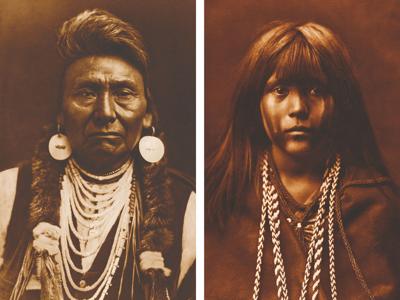

The new Curtis Gallery in downtown Monterey is open for business. And I do mean business.
They’re selling photographic images, but it’s not a dedicated photo gallery. It’s a sales office in the same configuration as when it was Treehouse Mortgage. There are two desks penned in by low cubicle walls in the middle of the carpeted floor; the surrounding enclosed offices are now mini galleries displaying artwork.
Instead of a gallery director or curator, the staff consists of two people with marketing backgrounds, and an accountant. They’re all about selling the art.
The namesake art in question are copper plate photos by Edward S. Curtis, symmetrically ensconced in glass and set in black frames – each one affixed with a business card tucked into the corner.
Curtis was born in Wisconsin in 1868 and caught the photography bug early. He joined the Harriman Alaska Expedition of 1899, and George Bird Brinnell’s 1900 expedition to the Blackfoot Confederacy in Montana, as a documentarian.
When he encountered Native American people on his travels, he conceived of a life-changing dream project: to photograph remaining tribes, and their customs and culture, before they were subsumed by Anglo colonization.
Few thought his project was achievable, but J.P. Morgan did and financed him, while Theodore Roosevelt lent public support. The project began in 1898.
Laurie Lawlor, author of Shadow Catcher: The Life and Work of Edward S. Curtis, writes that he traveled “by foot, horse and wagon, mule, boat, train, and auto… through every kind of terrain and climate… he faced rattlesnakes, rock slides, blizzards, hailstorms, endless rain, and occasionally unfriendly warriors.”
The project lasted for 30 years, and his devotion to it ruined his marriage, family life, finances and health.
But he finished it. He had taken 40,000 photographs on large glass negatives, and compiled 1,500 of those with text, and 20 portfolios of photogravure, into a magnum opus work of 20 volumes called The North American Indian.
He did portraits and candid shots from 82 tribes, hunting, riding, sitting, performing rituals and rites. Native Americans called him “shadow catcher.” And that’s apt to describe the process of his photography. It’s literally various continuous shades of darkness that creates the gradation and depth of the image. But he had proceeded with great respect for his subjects (“I never worked at them, I worked with them,” he said), and he wanted future generations to feel connected to Native American people.
Even so, The North American Indian wasn’t considered a success before Curtis died in 1952. But time has a way of changing the past. In the 1960s and 1970s his work began to be prized by historians, anthropologists, archivists and Native Americans.
Pulitzer Prize-winning novelist Navarre Scott Momday, who’s part of the Kiowa tribe of the Great Plains and helped start the Native American Renaissance, has said of Curtis’ work: “Never before have we seen the Indians of North America so close to the origins of their humanity, their sense of themselves in the world, their innate dignity and self-possession.”
Curtis’ work is in the Smithsonian, in museums and universities. It’s of irreplaceable historical importance. They are also in private collections and auctions.
In 1983, the Christian Science Monitor reported that two high-tech executives – one of them Kenneth Zerbe of Apple Computer – had acquired 2,207 of Curtis’ original photographic plates, and planned to make new prints to sell to collectors.
And now Zerbe, who lives in Carmel Valley, is selling the copper plates and vintage prints through Curtis Gallery. His sales team is managing director Karen Deaton, sales director David Hull and accountant Jody Lopes.
“It’s all for sale,” Deaton says. “We want people to enjoy them. We’re selling them framed or unframed.”
The copper plates are shiny metallic like new pennies. But the images are obscured by myriad surface reflections. Their value is more in their rarity and proximity to history than in the artistic details, which really come to life in paper prints. The gallery is selling copper plates for $6,000 to $24,000, and vintage prints from $300 to $1,200. But it’s worth a visit just to see the work.
The collection has representations of 32 or so tribes, mostly from the Pacific Northwest, Canada and Alaska, including the Kobuk, Chipewyan, Klamath, Tolowa, Yakima and Blackfoot.
The gallery’s website has biographical information about the subjects:
“The Hupa are a Northern California tribe. Their red cedar-planked houses, dugout canoes and basket hats identify them with their northern origin.”
Curtis made 38 plates of the Hupa: 12 have been donated to the Museum of the American Indian, 26 went to collectors.
These are beautiful works that, nearly forgotten, have contributed to the enlightenment of humankind. Curtis didn’t make a fortune or achieve fame in his lifetime, but he entered an even more hallowed place: He made history.
(0) comments
Welcome to the discussion.
Log In
Keep it Clean. Please avoid obscene, vulgar, lewd, racist or sexually-oriented language.
PLEASE TURN OFF YOUR CAPS LOCK.
Don't Threaten. Threats of harming another person will not be tolerated.
Be Truthful. Don't knowingly lie about anyone or anything.
Be Nice. No racism, sexism or any sort of -ism that is degrading to another person.
Be Proactive. Use the 'Report' link on each comment to let us know of abusive posts.
Share with Us. We'd love to hear eyewitness accounts, the history behind an article.