
There seems to be a homegrown gender war brewing. Women can serve in combat and are increasingly top household earners, but #Gamergate revealed vicious online attacks on women who challenged male dominance of technology, and Trump rose up on waves of misogyny and regression. On his show last week, Bill Maher mused to guest Hanna Rosin, author of The End of Men: And the Rise of Women, “Men just seem not to be able to navigate the modern world.”
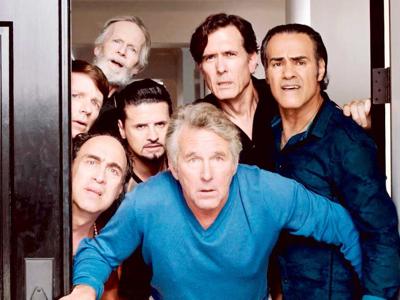
Into this climate comes the 2016 comedy Welcome to the Men’s Group, which re-creates a men’s group meeting as a slice of life in the greater men’s movement, which was launched by books like Robert Bly’s Iron John and Warren Farrell’s The Myth of Male Power. It’s playing April 27 in Pacific Grove.
“[The men’s movement] arose out of reaction to feminism of the 1970s,” says Joseph Culp, the movie’s writer/director and a 20-year men’s group member. “Men were being asked to look at themselves and re-evaluate their attitudes and evolve. What does it mean to be a man?”
That is explored through group meetings in which men are invited to reclaim their “original male energy” by sharing their feelings and grief through ceremony and ritual, poetry and myth, testimony and confession, chanting and drumming, dancing, touching, maybe a bit of nudity.
At least that’s how it’s portrayed in the movie. Culp admits to siphoning from what he’s seen at real-life gatherings.
Men’s groups as well as the men’s movement – with slogans like “Men are more than success objects” – has been ridiculed by everyone from Saturday Night Live to Fight Club toCollege Humor. Culp’s film giggles along, but leads us through to serious matters of identity, parental traumas, relationship hardship, addiction struggles and loneliness.
In the movie, eight men gather at the pristine McMansion of a group member (Timothy Bottoms). There’s the self-appointed leader (Culp), the macho Latino (Terence J. Rotolo), the burnt-out hippie (David Clennon), the white-collar schemer (Stephen Tobolowsky), the New Age flake (Phil Abrams), the wide-eyed newcomer (Mackenzie Astin) and the angry Iranian (Ali Saam).
They sit on expensive furniture and begin sharing, but they are undermined by their issues. It devolves into funny bickering, accusation, acrimony, defensiveness and fighting. And though it’s not autobiographical, it’s personal.
“I needed mentoring to heal childhood wounds, wounds from my father,” Culp says. “It’s a profound movement.”
His father was Robert Culp, a popular TV actor from the 1960s-’90s. (He co-starred with Bill Cosby in the 1960s NBC series I Spy.) In the ’70s, Joseph attended Stevenson School in Pebble Beach as a boarding student, where he was a self-described theater geek. He followed in his father’s footsteps and worked in theater, film and television.
One short-lived but significant role was on the series Mad Men, playing Don Draper’s father Archie Whitman – a drunk and a farmer who lived a rough and short life. In one dream sequence, Don, a successful ad man, imagines Archie deriding his manhood: “Look at your hands. They’re as soft as a woman’s.”
Joseph Culp says there is a connection between Mad Men and his movie.
“In the last episode, [Don] has lost himself,” Culp says. “He knows that what he’s been is not going to work anymore. He’s meditating. Maybe he’s going to open up, as men did in the ’70s, into the human potential movement. Don was at the beginning, [my movie] is 30 years on.”
But another way to look at that ending, with its dissolve into the singing Coke commercial, is that Draper evolved not into a better man, but into a better liar.
A metaphor in Culp’s movie is the contrast between the civilized house and the primal chaos of the men’s feelings.
“Sometimes we have to get back to something ancient and real,” Culp says.
There are issues. That “ancient” something is often borrowed piecemeal from cultures that may not be represented by actual people from those cultures. Women characters are portrayed in the movie on the periphery, as sexual beings, or hysterical, or emasculators. And the men in the movie are mostly privileged.
That’s going to contrast with a short film by Michael Buffo that will show before Culp’s feature. It’s about about the Freedom Within Prison Project, a men’s group that’s been going into Salinas Valley State Prison for six years to try to rehabilitate the men there.
“Realizing I had feelings, understanding them, express[ing] them, allowed me to put myself in other people’s shoes,” one inmate says. “Especially my victims.”
Joseph hopes viewers will be able to transition between “the sublime to the ridiculous.” He’ll help by doing a Q&A, and will be joined for a discussion by reps from local men’s groups including Breakthrough for Men and the Mankind Project of Monterey.
“I see [my movie] as a response to throwback misogyny,” Culp says. “The old paradigm is dying. Women are invited to see this film as reassurance that men are not regressing… and what we’re seeing in politics is the last gasp of an old patriarchy that cannot and will not stand.”
(1) comment
"but #Gamergate revealed vicious online attacks on women who challenged male dominance of technology,"
Minor correction here, Gamergate was a consumer backlash movement against the game journalism industry over the cover-up of some conflicts of interest. It wasn't involved attacks against any women in the tech industry, although many death threats were sent to the men and women supporting Gamergate
Welcome to the discussion.
Log In
Keep it Clean. Please avoid obscene, vulgar, lewd, racist or sexually-oriented language.
PLEASE TURN OFF YOUR CAPS LOCK.
Don't Threaten. Threats of harming another person will not be tolerated.
Be Truthful. Don't knowingly lie about anyone or anything.
Be Nice. No racism, sexism or any sort of -ism that is degrading to another person.
Be Proactive. Use the 'Report' link on each comment to let us know of abusive posts.
Share with Us. We'd love to hear eyewitness accounts, the history behind an article.