
After the December 7, 1941, Japanese naval attack on Pearl Harbor, Japanese submarines patrolled the West Coast of California, attacked merchant ships, and fired on an oil field near Santa Barbara. In response, California became something like a militarized zone.
Blackouts were ordered, martial law was declared in Los Angeles Harbor, barbed wire was strung across beaches, and military presence ramped up. Fort Ord’s mechanized 7th Division was sent to the Aleutian Islands in Alaska to fight Japanese forces.
Rumors arose that people of Japanese ancestry were sleeper agents, that Japanese fishing boats were setting naval mines. Ethnic fears turned into harassment, then into U.S. policy when, in February 1942, Franklin D. Roosevelt issued Executive Order 9066.
“Many historians view EO9066… as one of the darkest chapters in U.S. civil rights history,” local historian Tim Thomas says in an email.
It expelled people of at least one-sixteenth Japanese descent – most of them American citizens – from the Western states. If they did not voluntarily leave, they would have six days to divest of their belongings and property, pack what they could carry, and be forcibly sent to incarceration camps – barracks in desolate locations, with armed guards and barbed wire – across the West.
Some 1,800 Italians and 11,000 Germans – almost none of them U.S. citizens – were interned under the Alien and Sedition Acts; about 120,000 Japanese Americans were incarcerated during the war under EO9066 for up to three years.
Locally, Japanese Americans were assembled, housed (sometimes in horse stables) and processed at Salinas Rodeo Grounds before being taken by train to a camp. Larry Oda, former national president of the Japanese American Citizens League and a Monterey resident, was born in one of them in Crystal City, Texas.
“Crystal City was the only family camp,” Oda writes by email. “The total population was about 4,000, two-thirds of Japanese ancestry and included 660 Peruvian Japanese and 600 Hawaiians.”
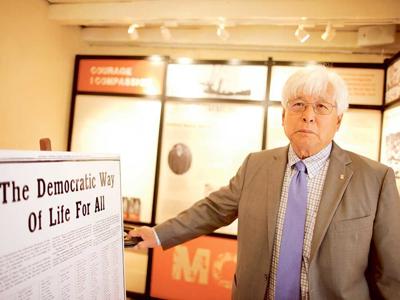
A traveling exhibit titled Courage and Compassion: Our Shared Story of the Japanese American WWII Experience – launched by the Go for Broke National Education Center and received locally by the Japanese American Citizens League of the Monterey Peninsula – tells the stories of 10 cities throughout the West that were involved in the Japanese Americans’ plight. It’s full of historical photographs, informational graphics and text labels.
One photo is of young men from the Japanese community at Monterey’s train station in March 1941 on their way to boot camp, including Royal Manaka, who joined the legendary Japanese American 442nd Infantry Regiment (their slogan: “Go for broke!”). He still lives in Seaside.
There is an infographic about the number of Japanese Americans who served in the U.S. Armed Forces during World War II (33,000) and the numbers killed or missing in action (800).
There are clips of letters to the editor, published in the Monterey Peninsula Herald, arguing over an ad by a local organization trying to prevent Japanese Americans from returning to California after the war.
That elicited a shining moment in the form of a petition signed by more than 440 people – including John Steinbeck, Edward Weston, Robinson Jeffers, Ed Ricketts, and many community members – supporting their return home.
“Monterey is a small town,” says Thomas, who uncovered the petition in 2013. “They all knew each other, grew up together, went to school together.”
Author Julie Otsuka talked about her family’s incarceration camp experience at CSUMB last week. And this Sunday, Oct. 28 (the day after the exhibit closes), a film titled Enduring Democracy, about Monterey’s response to Japanese scapegoating, screens at the Monterey Public Library.
The incarceration of Japanese Americans shares disturbing parallels to the Nazi persecution and rounding up of Jewish people during Hitler’s rise to power. Have we forgotten those lessons?
“The current administration is proposing similar actions against a group of people for the same reasons we were targeted – racial prejudice, hysteria and a failure of political leadership,” Oda says. “We hope that this exhibit will reinforce [people’s] idea of equality under the law.”
The Monterey component of Courage and Compassion will stay in Monterey, and will be housed at the Heritage Room of the Monterey JACL, when it reopens in early 2019, so that history will be remembered. Like that of Mitsuye Endo.
The daughter of Japanese immigrants, she had never been to Japan, but was fired from her California state job and sent to an incarceration camp. She was enlisted by the JACL to serve as a habeas corpus case to challenge the constitutionality of the arbitrary imprisonment of Japanese-Americans. The government offered her freedom if she dropped the case, but she declined, opting to go all the way to the Supreme Court, where it was ruled unconstitutional in December 1944, effectively freeing incarcerated Japanese-Americans and closing the camps.
COURAGE AND COMPASSION is viewable 10am-4pm Thursday-Saturday, Oct. 25-27, at Casa Guitierrez, 590 Calle Principal, Monterey. Free. goforbroke.org, jaclmonterey.org.Enduring Democracy screens 2pm Sunday, Oct. 28, at Monterey Public Library, 625 Pacific St., Monterey. 646-3933.
CORRECTION: A previous version of this story mischaracterized the Ex parte Mitsuye Endo lawsuit as a case against Executive Order 9066. It was not. In Korematsu v. United States, the Supreme Court sided with the government in a 1944 decisions for EO9066, which was repudiated by the court in June of 2018 in Trump v Hawaii.
(0) comments
Welcome to the discussion.
Log In
Keep it Clean. Please avoid obscene, vulgar, lewd, racist or sexually-oriented language.
PLEASE TURN OFF YOUR CAPS LOCK.
Don't Threaten. Threats of harming another person will not be tolerated.
Be Truthful. Don't knowingly lie about anyone or anything.
Be Nice. No racism, sexism or any sort of -ism that is degrading to another person.
Be Proactive. Use the 'Report' link on each comment to let us know of abusive posts.
Share with Us. We'd love to hear eyewitness accounts, the history behind an article.