
In their capacity to use film to inform through showing and storytelling, documentaries wield power. They used to be prohibitively time – and cost-intensive to make. But when digital technology, online bandwidth and the guerilla style of Michael Moore converged, the once-rarified genre exploded in number and diversity.
Some of the films of the Monterey County version of Santa Cruz’s Reel Work Labor Film Festival look DIY. But their appeal hinges on being fresh off the server, bypassing corporate media, being real. They also advocate a political position.
When Voices Meet, which opens the festival Thursday, recalls the 500 multiracial choir kids who traveled the so-called Peace Train to perform in defiance of South Africa’s apartheid in the 1990s.
The last film, Tuesday’s How to Let Go of the World: And Love All the Things Climate Can’t Change by Josh Fox, the Oscar-nominated director ofGasland, travels the world to find the silver lining in climate change doomsday scenarios.
But most of the festival devotes itself to work and unionizing.
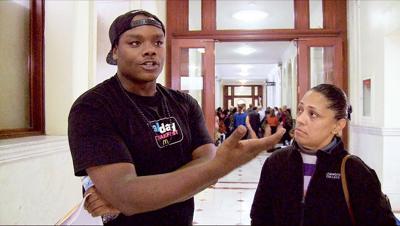
Dan Albright and Andy Keyes, both 21, made the 20-minute film A Living Wage, about the “Fight for $15” campaign to raise the minimum wage in Boston, led by Dunkin’ Donuts barista Tiny Figueroa and McDonald’s fry cook Darius Cephas.
In one scene, they follow Figueroa as she’s cleaning a chain store toilet with gloved hands (“We got some nasty people that come here”), getting on the subway after work, going into her home, and tabulating her bills for the camera.
They shoot Cephas as he pumps up other fast food workers and supporters with a megaphone. Then, to his modest home where he gets dressed to go to work and says, “I flip burgers because I have to pay bills, because I have to eat.”
He says he makes $191 at McDonald’s in a four-day week.
There are snippets of Bernie Sanders supporting the Fight for $15 movement, and of the Democratic National Committee adopting it into their national platform. The filmmakers give time to a smarmy fast food lobbyist, but there’s little pretense of objectivity.
“We made it clear to Tiny and Darius that it was our intention to use our platform in order to spread their message,” Albright writes in an email.
The film’s allusions to class issues are subtext; its local relevance is real. Days after the California Faculty Association called off their strike against the California State University, after securing a tentative agreement, faculty union members joined the picket lines of fast food workers, according to CSUMB history lecturer Meghan O’Donnell.
The lesson: These films reverberate in the real world when they move people to act in unison.
THE REEL WORK LABOR FILM FESTIVAL runs 8:15pm Thursday and noon Friday at CSU Monterey Bay, and 7pm Tuesday at Monterey Peace and Justice Center, Seaside. Free; donations accepted. www.ReelWork.org
(0) comments
Welcome to the discussion.
Log In
Keep it Clean. Please avoid obscene, vulgar, lewd, racist or sexually-oriented language.
PLEASE TURN OFF YOUR CAPS LOCK.
Don't Threaten. Threats of harming another person will not be tolerated.
Be Truthful. Don't knowingly lie about anyone or anything.
Be Nice. No racism, sexism or any sort of -ism that is degrading to another person.
Be Proactive. Use the 'Report' link on each comment to let us know of abusive posts.
Share with Us. We'd love to hear eyewitness accounts, the history behind an article.