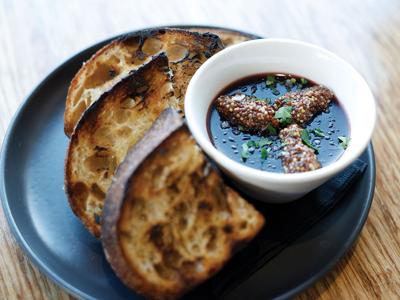

Occasionally someone here or there takes note of an unexpected resurgence. “A Way of Life,” boasts a 2001 article. “From Traditional to Trendy,” reads a headline from 2018. Yet pâté continues to struggle to fully emerge from its dark corner of the culinary pantry, where ancestral dishes such as coq au vin and stuffed filet of sole reside.
“Does the world still love pâté the way we did?” asks Chef Todd Fisher of The Meatery in a rhetorical tone, speaking of a time when few children squirmed at liverwurst. “I remember restaurants serving chopped liver.”
Indeed, stroll through local restaurants a few decades ago and you were likely to find pâté maison or pâté du chef en gele next to foie gras de Strasbourg featured on menus. But today only perhaps five – six when The Caledonian opens its doors – restaurants on the Peninsula prepare the dish.
Carmel’s Anton & Michel serves a duck liver pâté alongside a toasted baguette, with cornichons, pickled mustard seeds and a wild berry confit – sharp flavors to contest with the richness of the spread. L’Escargot, also in Carmel, offers a blend of duck and pork. Chef Jonny Black at the Michelin star destination Chez Noir – a third Carmel spot listing the hors d’oeuvre – brings it to the table en croûte, a traditional French service.
“For our restaurant, it sells well – which surprised me,” says Chef Jerry Regester of The Spotted Duck in Pacific Grove.
Regester makes his version from duck liver and cream, seasoned with a few dashes of five spice powder and “some other things.”
“I wanted to go off what I remembered, a creamy, luscious pâté,” he adds. “It fits what we do – bistro fare.”
The pâté at Spotted Duck is opulent, with a staid minerality. Port gelee seeps over the presentation – a bittersweet notch in the hearty spread, with dour pops of mustard seed. Scraped onto sourdough scorched by the grill, the mind wanders to gray, weather-worn barns full of curing fruit and the earthy gloaming of a damp country evening.
So why would such a dish ebb more than flow – particularly at a time when the traditional ethics of “nose to tail” and “farm to table” are in favor?
“I don’t have an answer for that,” Regester says.
Fisher suspects that the expansion of America’s culinary interests that started in the 1980s and spawned a fusion of global flavors has something to do with the tired appearance of pâté. French restaurants – once considered the apogee of fine dining – must now share the space. Yet demand is such that Fisher routinely stocks five or six selections, both imported and prepared in-house, for use at home, as well as for the deli lunch following.
“We love it,” he says. “We put pâté on our banh mi, which is traditional, but not common now.”
Fisher speaks highly of a version made from guanciale and rabbit, before pausing mid-thought: “Although that’s more of a terrine.”
There are other spreads than pâté, even within the French culinary tradition. Pâtés are typically assembled from sautéed organ meats and seasonings – herbs, spices or even spirits – that are ground into a spread. Ingredients for terrines, on the other hand, are layered into a loaf and cooked slowly.
Stokes Adobe in Monterey serves a duck liver mousse, another presentation – more wispy, often with a reserved hand when it comes to spices.
There are other styles, of course. The smoldering Italian nduja has gained in popularity, even as other Old World spreads continue to tread the culinary trend waters. Nduja’s rise can be attributed to the favor currently granted to Calabrian chile.
The Meatery’s chef and owner wonders if the craft has just been lost to modern chefs. But Fisher also observes that it’s a perishable item, and restaurateurs are loath to list dishes that teeter on the fringe of fashionable.
“We’re not in France, where they spread it on sandwiches and it’s on every corner,” he adds.
But pâté has gained enough attention from the dining public that some restaurants sell enough to keep it on menus. “It’s almost like a lost art form,” Regester says, adding a caveat: “Everything comes back eventually. All it takes is a social media blast: ‘Pate is the new in thing.’”
(0) comments
Welcome to the discussion.
Log In
Keep it Clean. Please avoid obscene, vulgar, lewd, racist or sexually-oriented language.
PLEASE TURN OFF YOUR CAPS LOCK.
Don't Threaten. Threats of harming another person will not be tolerated.
Be Truthful. Don't knowingly lie about anyone or anything.
Be Nice. No racism, sexism or any sort of -ism that is degrading to another person.
Be Proactive. Use the 'Report' link on each comment to let us know of abusive posts.
Share with Us. We'd love to hear eyewitness accounts, the history behind an article.