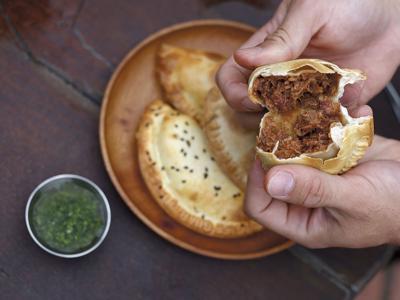

Some dishes travel well, or perhaps are well-traveled – or both.
Take the hand-held savory pie, for example. It is street food found in sit-down restaurants, a miner’s basic sustenance elevated to standalone appetizer.
Almost every culinary culture claims one – or more. There is a simple explanation for the ubiquity, according to Kodey Sommer, sous chef at Estéban Restaurant in Monterey: “They are easy to eat, portable and have a lot of flavor in one bite,” he says. “Empanadas are a favorite amongst our guests.”
Estéban, which features Spanish flavors, serves some 300 empanadas each week – puff pastry filled with braised pork and feta then fried until flaky and comforting. At Café Guaraní in Pacific Grove, the empanadas are baked. In the beef version, the husky filling takes kindly to a dab of chimichurri. Café Guaraní’s is a Paraguayan style. The sauce shares a gentle, grassy tone and just the outline of heat with the beef.
But which one is proper? It turns out there are no rules here. They can be baked or fried. The dough can be formed from native plants – plantain, yucca – or pie dough. At London Bridge Pub in Monterey, the pastry comes smothered in a brown gravy. And recipes don’t just vary from culture to culture.
“There are so many meat pie varieties in Spain,” Sommer explains. “The dough is different depending on the area. Fillings can be meat, chorizo with hard boiled eggs.”
Three types of hand-held savory pie are common in Monterey County restaurants. And each is both ancient in origin and well-traveled.
So where did they come from?
The first print reference to empanadas known to exist is found in a Spanish cookbook from 1520. While Spanish conquest brought empanadas to the New World, where it spread and was adapted, scholars believe the popular dish to be derived from the Middle Eastern sfiha, likely introduced to Spain by the Moors.
Samosas rival empanadas in familiarity here. “Gosh,” is all Rajesh Chunara of Aahba Indian Cuisine in Carmel can muster when it comes to numbers prepared each day. Often more than 30 a night go from kitchen to tables.
The recipe for Aahba’s samosas is vegetarian, with potato, peas, cumin and other spices – no garlic, no onion. And many consider this the traditional version. Yet at Ambrosia India Bistro in Monterey, chicken or lamb is sometimes an addition. Ambrosia’s chicken filling is mild in nature. The meat drifts into the background, allowing the peas and spices to tap sweet, earthy and herbal notes on the palate.
And in fairness, Chunara notes, “In India now we have a lot of varieties.”
Again, scholars trace the samosa not to the subcontinent, but to ancient Persia. The oldest reference dates to the 11th century and describes a pastry filled with meat, dried fruit and nuts.
Eventually what became modern samosas swept into India, to again be transformed over and over according to region – and especially by the New World, where Europeans first encountered the potatoes now essential for the typical filling recipe.
So it’s clear the hand pies are readily adaptable. But before we concede that the Middle East appears to be the likely origin – it was the cradle of civilization – no one really knows who first folded meat or other savory ingredients in dough. We just know that they spread rapidly around the globe.
According to the Cornish Pasty Association, the British version has been around since at least the 13th century. By the time it became associated with Cornish miners, the pasty was a hefty thing, with a thick crust rumored to be able to survive a mineshaft tumble. The meat and vegetables inside formed a natural gravy. Alas, gravy ladled over the version at London Bridge Pub takes it out of the hand-held realm – although, to their credit, a meaty, peppered brown gravy is good on most anything.
There is another filled dough common to the area. It is thought that pupusas first appeared in what is now El Salvador some 2,000 years ago. But culinary pedantics will note that these have more in common with griddle cakes than pies.
So common fare is well-traveled. As Aahba’s Harsh Bhati says of samosas, “In Delhi – restaurant or street food, 10 to 1, people go for street food.”
(0) comments
Welcome to the discussion.
Log In
Keep it Clean. Please avoid obscene, vulgar, lewd, racist or sexually-oriented language.
PLEASE TURN OFF YOUR CAPS LOCK.
Don't Threaten. Threats of harming another person will not be tolerated.
Be Truthful. Don't knowingly lie about anyone or anything.
Be Nice. No racism, sexism or any sort of -ism that is degrading to another person.
Be Proactive. Use the 'Report' link on each comment to let us know of abusive posts.
Share with Us. We'd love to hear eyewitness accounts, the history behind an article.