
In 2016, the Italian city of Verona sought to ban restaurants that were not sufficiently native. The goal was to preserve culinary tradition.
It’s not a far-fetched idea. In 1972, Diana Kennedy’s The Cuisines of Mexico dismissed the Tex-Mex style most Americans were familiar with, providing an introduction to authentic regional cooking. As America’s interest in global flavors grew through the 1990s and 2000s, authenticity became a trigger. Critics would call out restaurants with the audacity to offer chimichangas, say, on their Mexican menus.
What’s wrong with chimichangas? The most common origin stories center on restaurants in Tucson – there are at least four that claim to have invented the dish – a burrito accidentally dropped into the fryer and the exclamation “chingada!” from the cook.
So it is Mexican only if you buy into one of the other tales about the chimichanga. But Chinese immigrants in Sonora using tortillas to create a kind of egg roll is not as interesting in the telling. It does, however, bring into question the idea of culinary authenticity. Kennedy had hoped to cast Tex-Mex as separate from true Mexican. However, many took her admonition as a declaration of a distinct cuisine with an authenticity of its own, validating the chimichanga.
Yet Tex-Mex (or spin-offs like Cal-Mex) is a product of cultural influences, new ideas and techniques, the availability of ingredients – the very forces that define all cuisines, and the forces that cause them to constantly evolve.
It would have been unthinkable for a so-called foodie of the 2000s to step through the doors of a Panda Express. But in 2016 – the same year Verona tried to clamp down – Business Insider labeled the quick-service franchise “the most authentic American Chinese chain in the world.”
There are Panda Express locations in Monterey, Seaside and Salinas. At each you can find orange chicken, a dish said to have been created by the chain’s executive chef, Andy Kao, in 1987.
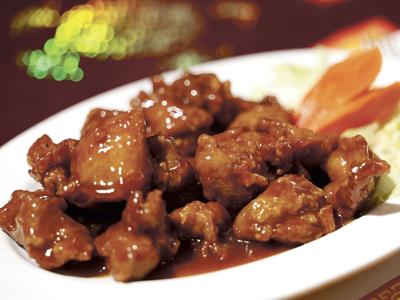
You can also order orange chicken at Chef Lee’s Mandarin House in Monterey, Instead of a bright, candied presentation, Chef Lee’s tempers the fresh nip of orange with a smoldering earthiness and brush of salinity from soy sauce. The crisped chicken takes on a more hearty, somber tone – a depth missing from the Panda Express original. It’s as if orange chicken had actually been conceived in China.
In the 2008 book The Fortune Cookie Chronicles: Adventures in the World of Chinese Food (spoiler: the cookies? not Chinese), Jennifer Lee explains the progression of cuisine. There were ingredients readily available to Chinese cooks in America that were inaccessible in the home country. At the same time, some items common in China were scarce here. So chefs adapted.
Cooking has always been in a state of change dating back to the spice trade or even further in the past. Potatoes were never associated with Ireland until brought from the New World. Katsu would have been unthinkable in Japan but for Portuguese sailors. Who in the U.S. of the 1990s had heard of Sriracha or gochujang?
In an Instagram post, celebrity chef Jenny Dorsey questioned what people actually mean when they wield the word “authentic.” She distilled the notion into three categories.
Perhaps the most common use is what she refers to as “a weaponized use of the word,” often seen in Yelp rants and based on “an assumption that cuisine/culture doesn’t evolve.” The other two are more favorable: a reference to a personal experience with a cuisine or an association of a specific flavor with a region. In other words, if the first dish a person tried at a Mexican restaurant was a chimichanga, there is an authenticity to it.
The deep-fried burrito has been a fixture on the menu at La Tortuga almost from the day the Seaside Oaxacan restaurant opened in 1999. The flour tortilla – if there is a rule to chimichangas, it’s that flour is a must – wrestles with the oil just long enough to develop a crispy sheen without becoming brittle. The calm, nutty savor of the shell allows the rich, bittersweet char of carne asada a confident stride.
There is a reason adaptations such as crab rangoon, General Tso’s chicken or the California roll catch on. It is the same reason that authenticity, as a culinary concept, should be considered with blurred lines, if at all.
(0) comments
Welcome to the discussion.
Log In
Keep it Clean. Please avoid obscene, vulgar, lewd, racist or sexually-oriented language.
PLEASE TURN OFF YOUR CAPS LOCK.
Don't Threaten. Threats of harming another person will not be tolerated.
Be Truthful. Don't knowingly lie about anyone or anything.
Be Nice. No racism, sexism or any sort of -ism that is degrading to another person.
Be Proactive. Use the 'Report' link on each comment to let us know of abusive posts.
Share with Us. We'd love to hear eyewitness accounts, the history behind an article.