
Does the name C.H. Nielsen ring a bell? How about Harold R. Basford?
The two were responsible for one of the most significant features of the American dining landscape, found from backyards to parks across the country. Yet not only have they been largely forgotten, their invention is considered run-of-the-mill. Writing in the journal Places, Cornell University’s Martin Hogue even noted that the device “is so ubiquitous that it is nearly invisible as a designed object.”
Still, the picnic table is a cultural clarion call. It beckons us to gather outside, to slow down – and to scale down. Even the fussiest of diners spurn miso butternut squash purée or ginger-crusted onaga in favor of simple fare from the grill. If lobster is on the menu, it comes overstuffed in a roll with mayo.
“It’s the most open and inviting table possible,” explains Rhett Nixon of Bear + Flag Roadside in Carmel Valley. “It’s comfortable, it’s open, it facilitates talking – to people at the table and at other tables.”
Although picnic tables are more often associated with campgrounds and patios, Bear + Flag is one of several Monterey County restaurants that take advantage of the table’s persuasiveness. They are parked outside of Salinas City BBQ and next to Monterey’s El Estero Snack Bar. Some of the tables at Lucy’s on Lighthouse in Pacific Grove are under a roof, lending a covered patio vibe.
The patch of grass by Carmel Valley Road set aside for picnic tables at Bear + Flag adds a touch of nostalgia. Starting in the 1930s, picnic tables began to appear in shaded spots next to highways across the country. Travelers could pause for a moment and unpack a meal.
But there’s a bonus. When a restaurant has picnic tables, guests only need to order to take in the spirit of the community table.
The popular little joint’s burgers speak of backyard grills – a haze of acrid smoke drifting from the charred crust over husky beef, presented without formality, juices dripping everywhere.
“They remind me of childhood,” says Daniel Dabney, manager of Snack Shack at Lovers Point, of the tables. “Where you’re likely to find them are at places you want to be outside.”
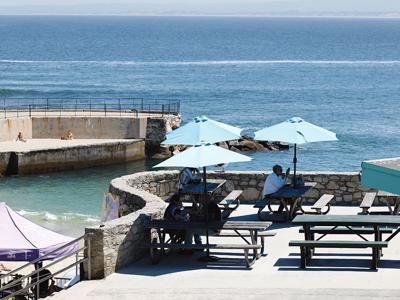
Snack Shack’s smashburgers are pressed near flat, with a crispy patina and savor that teeters between the rustic nature of meat and the dense rasp of a well-used griddle. But the true draw to the city-owned tables is more likely the setting, overlooking the beach.
The tables erase time. Dabney says that one couple comes every week, sitting for hours playing games. Another person settles onto a bench and paints the scenery.
“I think that is so fun,” he adds.
With a menu of hot dogs and milkshakes, Lucy’s on Lighthouse is right for picnic tables. “People love to sit outside,” says Joleen Green, the jovial spot’s owner. She sees the humble bench tops as community gathering spots. “It’s being able to sit with the dogs and kids.”
Before the table, picnics were generally held on blankets. An 1846 canvas by artist Thomas Cole dubbed A Pic-Nic Party illustrates such an event. Guests have toted baskets of food and drink and instruments for amusement through the woods to an open space by a body of water. One blanket is for adults, another for children.
But there is an element of discomfort in this idyllic scene. People crouch, kneel or sit awkwardly on hard ground.
Just a few years later, this problem was addressed by Jerome B. Thompson’s painting Picnick at Camden, Maine. The 1855 work shows a gathering under a canopy of trees, with diners seated at tables – not picnic tables, but family furniture lugged from the house to the field.
Obviously this method lacked the ease of packing a blanket. That’s where Nielsen and Basford come in.
Following the lead of other inventors, Nielsen received a patent in 1904 for a table that could be folded flat for transportation. His plan called for seats on both sides of the table.
According to Hogue, Basford’s “Folding Table,” patented in 1918, is the first draft of the modern picnic table. The design has hardly changed since – merely tweaked here and there for size and stability.
One can argue that dining on such a table on a restaurant’s ground defies the Victorian picnic ethic of a day in nature. But Green points out certain advantages. “There are no ticks on our patio,” she says.
(0) comments
Welcome to the discussion.
Log In
Keep it Clean. Please avoid obscene, vulgar, lewd, racist or sexually-oriented language.
PLEASE TURN OFF YOUR CAPS LOCK.
Don't Threaten. Threats of harming another person will not be tolerated.
Be Truthful. Don't knowingly lie about anyone or anything.
Be Nice. No racism, sexism or any sort of -ism that is degrading to another person.
Be Proactive. Use the 'Report' link on each comment to let us know of abusive posts.
Share with Us. We'd love to hear eyewitness accounts, the history behind an article.