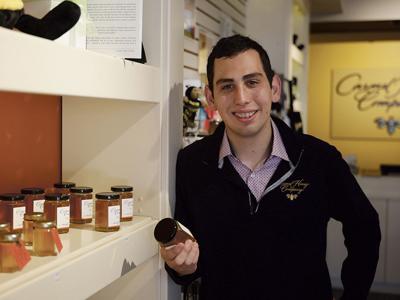

Ah, the sweet taste of success.
With four retail locations – two in San Francisco – Carmel Honey Company has clearly secured a niche in the artisan food market. But there was one measure of accomplishment owner Jake Reisdorf couldn’t quite put his finger on. Just how much honey had they sold?
Answering the question was not as simple as opening a spreadsheet. Carmel Honey Company began out of the Reisdorf family’s Carmel home 10 years ago, and for a time he was content to sell at farmers markets. But he had an idea where he could find a number.
“I called the glass company,” Reisdorf says.
This year, the honeybee operation that began as a fifth-grade homework assignment – Reisdorf earned an A for his mock honey company website – passed the milestone of 150,000 jars sold. And Reisdorf, who turns 22 this month, says he continues to learn about bees, business and especially his sticky sweet product.
“We didn’t have a lot of experience in retail or agriculture,” he recalls. “I thought honey was honey.”
Carmel Honey Company now features four different varieties. Orange blossom is like a burst of citrus zest, fresh and clean, complemented by impressions of dried petals. The syrupy note is muted, making for a light, easy finish. Sage comes from a plant – black button sage – that grows wild. It yields a honey that is pale in hue and compelling on the palate, with notions that are floral and buttery.
Meadowfoam may be the most unique. An umber honey, it coats the palate in rich tones of butterscotch and marshmallow, finally developing a faint campfire note.
Reisdorf compares honey to wine, in that terroir and growing season will come through in the flavor profile, which can vary from year to year. One of the reasons is that while bees tend to focus on a particular flowering plant, they are also attracted to others in the area. According to Reisdorf, bees at work will travel in a radius up to five miles. So a specialty honey labeled sage or orange blossom is typically 80 – to 90-percent single flower. The rest could be anything in bloom.
But that’s a record far better than commercial honey found on grocery shelves. Multiple studies in the U.S. and overseas have found the product to be diluted with corn or other syrups – or faked entirely – to lower the cost.
Research by the European Commission, for example, determined that 46 percent of commercial honey had been adulterated. A study by the Honey Authenticity Project in the U.S. identified a third of the samples as diluted or faked. But some have pegged the figure closer to 70 percent.
“There are not a lot of rules in place,” Reisdorf observes. “There’s a lot of misinformation.”
Fortunately, the popularity of artisanal honey – the real thing, unadulterated – is on the rise. It was interest in local honey that created Carmel Honey Company. Reisdorf had been fond of bees as a child and acquired a hive. When he presented his fifth-grade project, people asked if the honey was for sale. Later, at farmers markets, customers begged him to open a brick and mortar location.
“I’ve been grateful for all the support,” Reisdorf says. “We’ve gained a lot of followers.”
Reisdorf now has 180 hives, each supporting up to 60,000 bees. A hive can produce 80 pounds of honey in a year. A beekeeper works with farmers and landowners. For the orange blossom honey, Reisdorf hauls the bees to orchards in the Modesto area. He ventures to Oregon for the meadowfoam.
“It’s like a little roadshow,” he says.
Across the U.S., there are more than 300 different artisan honey varieties. Reisdorf has tried some exotic flowers, such as buckwheat.
The most popular version, at least for Carmel Honey Company customers, is something more familiar, however. Wildflower is mild and friendly, with a comforting caramel sensation. It’s the profile most people associate with honey. People are often not aware that it can vary.
“Honey is a niche,” Reisdorf points out. “It helps when people can come into the store and taste.”
And that is clearly working.
(0) comments
Welcome to the discussion.
Log In
Keep it Clean. Please avoid obscene, vulgar, lewd, racist or sexually-oriented language.
PLEASE TURN OFF YOUR CAPS LOCK.
Don't Threaten. Threats of harming another person will not be tolerated.
Be Truthful. Don't knowingly lie about anyone or anything.
Be Nice. No racism, sexism or any sort of -ism that is degrading to another person.
Be Proactive. Use the 'Report' link on each comment to let us know of abusive posts.
Share with Us. We'd love to hear eyewitness accounts, the history behind an article.