
During basic training it was evident that Byron Hoffman was being groomed for infantry service, most likely in Vietnam. But a stroke of fortune – in this case an injury and subsequent surgery – sent his military career in a different direction.
Hoffman ended up as a cook at Fort Ord through 1967 and ’68 – five different salad options, steaks grilled to order; “they loved my chow,” he recalls.
But roll military history back a generation and reviews of mess hall fare were not so positive. Hoffman heard so from his father, who served during World War II: “He said it left a lot to be desired.”
Apart from a few notorious rations – “ham and motherfuckers,” the derisive term for a particular meal in Vietnam – the men and women who served since the 1960s have comparatively few complaints when it came to the chow line. Reforms had been made to Army food service in particular, following a 1945 report condemning mess hall fare as “definitely below the accepted practices” of restaurants.
“It wasn’t the Whaling Station,” observes Kevin Hawes, who joined the Army in the early 1980s and was posted to Korea. “But it was all you could eat. How bad could that be?”
The culinary world has not been kind to some staples of mess halls past. Dishes such as chicken a la king and turkey tetrazzini are generally found only in the frozen food aisles. Granted, meals were not always as discouraging as later generations were led to believe. But liver and bacon, stewed prunes, cabbage and pineapple salad – those have been thankfully forgotten.
There is, however, one 20th century dish that is almost universally remembered by those who served. Its acronym – S.O.S. – suggests a level of scorn for the once ubiquitous white gravy poured over toast. Yet this is tempered by an equal fondness – so much, in retrospect, that at three restaurants on the Peninsula, it is one of the most popular dishes.
“There are a lot of sayings I’ve heard,” says Alec Lucero of The Breakfast Club in Seaside regarding the initials, where at least one customer orders it by the gallon to take home and freeze for later.
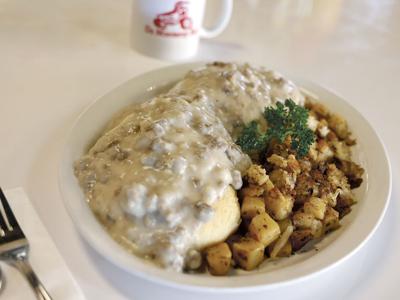
Hastily prepared from a field kitchen in the 1940s, creamed chipped beef on toast may have deserved dismissal as “shit on a shingle.” But at The Breakfast Club they prepare sausage gravy – rich and hearty, with a peppery backbone – to ladle over a choice of white, wheat, rye or sourdough (or a biscuit). It becomes comfort fare that is homey, filling and warming.
“You see it ordered a lot by older guys who have been in the military,” Lucero notes. “Some people come in just for S.O.S.”
At The Butter House, also in Seaside, the kitchen blends a combination of pork sausage and ground beef into their rustic country gravy. And most guests ask for it over biscuits or even rice. But one can order it properly, soaking into slabs of toast.
While listed as S.O.S. on the menu, Butter House general manager Jeff Walters describes the combination rightly as “a different take on biscuits and gravy.”
“It’s very popular,” he adds, a fact he credits to the area’s military and veteran population. “We sell a lot.”
So why did a dish that at a glance is familiar become so fractious? After all, the gravy itself – when seasoned with sausage – had long been welcomed by civilians as sawmill gravy or sausage gravy, well before the recipe first appeared in the 1910 Manual of Army Cooks.
Perhaps the culprit was chipped beef, which was more adaptable to certain field conditions. As a dried product, it had the advantage – as did evaporated or powdered milk – of shelf-stability when no refrigeration was available. And it was economical. The 1910 manual calls for a mere 15 pounds to serve 60 men in creamed form.
Chipped beef is still on the market. But in terms of both military and restaurant service, past tense is proper.
By the time Hawes served in the early 1980s (and even before), S.O.S. in military mess hall parlance referred to any form of gravy over biscuits or bread. Suggest Butter House, Breakfast Club or Grandma’s Kitchen in Monterey, which also features the dish, return to the original recipe, and the response will be firm.
“No,” Walters says. “Not in our recipe.”
(0) comments
Welcome to the discussion.
Log In
Keep it Clean. Please avoid obscene, vulgar, lewd, racist or sexually-oriented language.
PLEASE TURN OFF YOUR CAPS LOCK.
Don't Threaten. Threats of harming another person will not be tolerated.
Be Truthful. Don't knowingly lie about anyone or anything.
Be Nice. No racism, sexism or any sort of -ism that is degrading to another person.
Be Proactive. Use the 'Report' link on each comment to let us know of abusive posts.
Share with Us. We'd love to hear eyewitness accounts, the history behind an article.