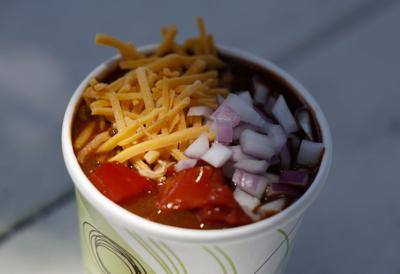

Many people harbor fond memories of Carmel Valley’s “Great Bowls of Fire,” a chili cookoff featuring both professional chefs and home cooks. Woody’s owner Tim Wood often bowled over attendees with his creations.
“I don’t know why he doesn’t have it on his menu,” wonders Parker Fisher of Bear + Flag Roadside in Carmel Valley.
Wood may just be following culinary custom. Few contemporary casual or fine dining chefs bother with such a homely dish. When they do prepare chili, it’s often with little fanfare.
“It’s a lesser-known thing that we do,” says Shane Cassidy, chef at Pebble Beach’s The Tap Room. “But when people have it, they come back year after year.”
The Tap Room may be the most upscale restaurant—the meat used is prime rib—preparing the staple. Jeffrey’s Grill & Catering in Carmel Valley lists chili, as does Old Monterey Cafe on Alvarado Street and Dubber’s Oldtown Bar and Grill in Salinas.
Chili is a fixture on the menu at Bear + Flag, too. But it serves a purpose. The team at the restaurant’s affiliated butcher—The Meatery in Seaside—carve away more than enough beef for burger patties and were looking for another way to use the trimmings.
Neither kitchen treats chili as an afterthought, however. Bear + Flag’s version begins with a stock prepared from three chiles, from which they prepare a consommé, and that’s before introducing caramelized red onion, tomato and a lot of meat. The resulting chili is swarthy, with a rugged spice like a desert sunrise. A natural sweetness slips through as a counterpoint to the modest yet unwavering heat.
Meanwhile The Tap Room has appointed one cook to chili duties. He’s been at it for so many years that Cassidy says “There’s no measuring, but it’s consistent.”
The meat has a savor reminiscent of a chuckwagon. The earthiness of beans contributes to the rustic, out on the range sensation. Cassidy observes that the chili is better if it sits for a spell before being served.
Between the two variations there exists, however, a dangerous chasm—which may be why chefs tend to shy away from chili, except for exhibitions like a cookoff.
According to the International Chili Society, acceptable styles include the traditional red that emerged in Texas, New Mexico’s green, vegetarian and a broadly defined homestyle. Within the categories are regional takes on chili, such as Cincinnati chili, which is piled onto spaghetti.
But there is the nagging matter of beans.
One guest left a scathing review of Bear + Flag on social media, merely because the chili has no such intruders. And Fisher insists that’s what beans are, at least when it comes to chili.
“There are no beans in the chili, and that’s the way it should be,” he says.
The folks at the International Chili Society agree—at least when it comes to Texas-style.
Historians generally place the origins of chili in Texas, although there is a tale of a Spanish nun two centuries earlier whose spirit left her body one night, traveled to land that would become Texas and returned with the recipe.
According to San Antonio food writer Robb Walsh, a group of Mexican women dubbed “The Chili Queens” dished out the stew for hungry citizens of that city from the 1860s. And there is another account that hints at the origins of chili, from George W.B. Evans in Mexican Gold Trail: The Journal of a Forty-Niner. “I will tell how beef is prepared for a long journey,” he wrote. “Take twenty-five pounds of beef and pounds of lard and of pepper, and procure the assistance of one or more Mexicans”—crediting Mexican cooks for inventing the dish. None of these early accounts mention beans. However, the ICS designation of homestyle makes room for beans in the conversation.
“It’s subjective,” Cassidy observes.
As to why upscale restaurants tend to ignore such a favorite, it’s simply assumed that chili is out of place. As Fisher notes, the steakhouse Seventh & Dolores in Carmel produces enough trimmings. “But I don’t think chili fits their menu,” he adds. “I don’t know.”
Cassidy agrees. Chefs prefer to showcase ingredients and technique.
“Where’s the innovation?” he says. “But sometimes it’s the simple things done well—that’s all it has to be. You want that comfort.”
(0) comments
Welcome to the discussion.
Log In
Keep it Clean. Please avoid obscene, vulgar, lewd, racist or sexually-oriented language.
PLEASE TURN OFF YOUR CAPS LOCK.
Don't Threaten. Threats of harming another person will not be tolerated.
Be Truthful. Don't knowingly lie about anyone or anything.
Be Nice. No racism, sexism or any sort of -ism that is degrading to another person.
Be Proactive. Use the 'Report' link on each comment to let us know of abusive posts.
Share with Us. We'd love to hear eyewitness accounts, the history behind an article.