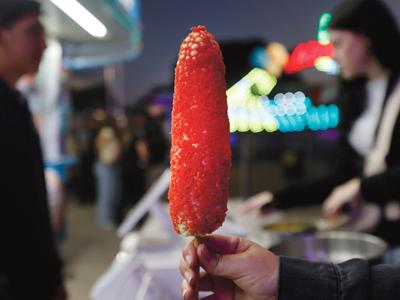

When food vendors come to town for the Monterey County Fair, they bring fiery dragon fries, deep-fried Oreos and other creations with carnival flair conjured for the occasion.
“We have a little more fun at the fair,” explains Alexis Parkhurst of Old West Cinnamon Rolls. “A Dubai chocolate cinnamon roll – you have to try it.”
There are expectations that come with fair food. For a weekend, people ignore the sensible limits of a healthy lifestyle. And culinary limits will be pushed.
Fans of the Cooking Channel series Carnival Eats might look for Buffalo chicken ice cream, deep-fried Coca-Cola or spaghetti and meatballs on a stick, but fair food vendors say that success is driven more by restaurant fundamentals.
“We’ve never done pizza on a stick, but we like to have fun,” says Dan Nelson of the pizza truck Fire & Slice. The crew prepares the dough from scratch – “it’s all about the crust” – and turns the pie in a 900-degree oven. Windows in the two-story vehicle allow customers to look on.
“We put on a little show,” he adds. “It’s perfect for the fair.”
Caesar Robles, a 10-year food truck veteran from a family that has been in the business for 75 years, brings new sandwiches with his Just Cheezen’ and Aaron’s Chicken Shack trucks. They are also known for mac and cheese cones, with additions ranging from bacon to Hot Cheetos. But he says quality foods made from scratch and customer service matter more than flair.
“In our business it’s all word of mouth,” he points out. “Somebody sees someone walking around; they’ll say, ‘Where did you get that?’ One bad review and you might as well pack up.”
The wild feature creations are part of an effort to attract people to a vendor’s location. Yet they may not be the biggest change to the fair food scene. Parkhurst – like Robles, part of a third-generation food truck family – recalls the vehicles she saw as a child in the 1980s. They tended to be smaller and more modest, perhaps with a string of lights. Then the next year, a rival vendor might hang two strands.
“Now you see huge trailers and lights everywhere,” Parkhurst observes. “It’s a race to see who is the most exciting. It’s friendly competition.”
Nelson’s team will prepare a dessert pie, topped with chocolate and marshmallows that can be tricky, timing-wise, in the intense heat of the oven.
“When we make it, we sell a lot of them,” he says.
Keep in mind that items now common were once fair curiosities, although many were introduced on larger stages. Cracker Jack was a hit at the 1893 World Expo in Chicago. The St. Louis world’s fair in 1904 brought hot dogs as we know them, ice cream cones and cotton candy to the masses. The latter – named Fairy Floss at the time (it was invented by a dentist, rather ironically) – was in such demand that the vendor sold 68,000 boxes.
The quintessential food on a stick came a few decades later. The Texas State Fair claims the corn dog, featured at the 1942 edition. However, there is a case for the Minnesota State Fair, which offered “pronto pups” a year earlier. And some date versions of the corn dog to the 1930s.
Still, it was a novel idea at the time. “That’s what’s different about fairs,” Robles says. “What’s the new thing to try? You have to get with the times.”
He’s on to something. County and state fairs were organized to showcase agricultural innovation and education, to further farming and ranching practices and the production of foods.
Writing in Science Meets Food, professor Elizabeth Clark suggests that new culinary concepts continue that spirit of innovation and education. Daring dishes such as deep-fried butter or burgers topped with ice cream “show how processing techniques are evolving to create food items we once thought incapable of existing.” To Robles’ point, they also express how perceptions of flavor evolve.
That is why both fairgoers and vendors share anticipation for the fair, and return for more.
“You get people who come year after year,” Parkhurst says. “They bring their kids. Working at the fair is hard, but we get to be a part of that.”
(0) comments
Welcome to the discussion.
Log In
Keep it Clean. Please avoid obscene, vulgar, lewd, racist or sexually-oriented language.
PLEASE TURN OFF YOUR CAPS LOCK.
Don't Threaten. Threats of harming another person will not be tolerated.
Be Truthful. Don't knowingly lie about anyone or anything.
Be Nice. No racism, sexism or any sort of -ism that is degrading to another person.
Be Proactive. Use the 'Report' link on each comment to let us know of abusive posts.
Share with Us. We'd love to hear eyewitness accounts, the history behind an article.