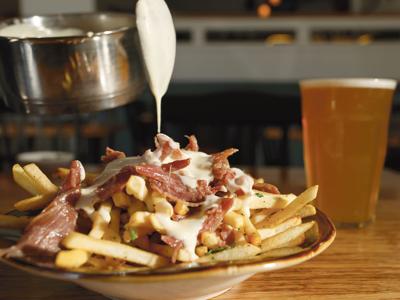

What’s in a name? That which we call a fry by any other name would… No, the subject of French fries would cause even the great Bard to stammer. There are, after all, more than a dozen styles – crinkle cut, waffle, shoestring – and even more ways to plate them.
And that versatility is what makes it so difficult to find agreement on the subject. Or as Ben Hillan, chef at Salt Wood Kitchen & Oysterette in Marina, points out: “There are a lot of opinions about what makes a great fry.”
Hillan calls himself a fry purist, which generally means a batonnet cut, blanched and then fried a second time with a rest in between, followed by a dusting of salt. But John Eales, owner of Monterey’s London Bridge Pub, prefers a thicker steak fry – sorry, chip – noting that tourists from England call them “proper chips.”
“Steak fries don’t stay crisp, but it doesn’t matter,” he adds. “You soak them in vinegar anyway. Putting ketchup on fish and chips is sacrilege.”
Sure, tossing in the matter of condiments just adds to the ambivalence. Ketchup is common in one culture, mayonnaise in another. Some presentations even call for gravy.
“I use a shoestring cut,” says Jerry Regester of Spotted Duck in Pacific Grove. “They are more consistent and they hold up to the cheese.”
Ah, yes. Cheese fries. One may shudder at the memory of late nights in college bars, but cheese fries can be easily elevated. For instance, Regester dresses the crispy thin potatoes in sauce mornay and duck confit.
“That will be going over to the new restaurant, as well,” he says, referring to the Grill at Point Pinos, which will be opening soon. “We have people who come just for the duck fries.”
So shoestring fries are functional. But Regester admits to a fondness for curly fries, a style prevalent in the 1990s often associated with the fast food chain Arby’s but actually traced back to the 1824 cookbook The Virginia Housewife; Or, Methodical Cook, where author Mary Randolph suggested cutting around the potato as one might peel a lemon, and dunking the curls in hot oil.
Pinning down the history of fries – or chips, pomme frites, patatas bravas, whatever else – is as difficult as settling on the best method or presentation. To start with, they may not even be French, despite the title bestowed by Americans.
Belgians are adamant in claiming pomme frites. In their telling, plummeting temperatures during the winter of 1680 caused the Meuse River to freeze at Namur. With no access to fish, people of the city – or the fishermen themselves, in some versions of the story – fried strands of potato, instead.
Others have found reason to doubt this tale. For one, potatoes were new to the Old World, having been introduced by Spanish explorers just a century before. They did not appear in French cookbooks until the late 1700s, when street vendors in Paris reportedly made them popular. Thomas Jefferson is said to have brought the concept to the U.S. – not as French fries, but as a decidedly less catchy “potatoes deep-fried while raw, in small cuttings.”
Another story finds a German chef trained in France peddling fried slices of potato sometime in the early 1800s, suggesting that they were a novelty at the time. Yet Belgium insists, and has asked that pomme frites be deemed one of the country’s cultural treasures by the United Nations.
If there is one point of general agreement, it’s that American doughboys serving in France and Belgium during World War I concluded that frites were indeed French – although even this account has a contender, since Americans tended to prefer “Frenching” to the more proper “julienne.”
Eales just shakes his head. “You go to McDonald’s in England, it’s a burger and chips – or it was; everything is getting so international.”
So when it comes to fries, there is little consensus. Vin-by-the-Sea in Carmel serves Belgian-style, cooked twice for a crackling patina. Seaside’s Other Brother Beer Co. offers a waffle cut. Elsewhere you might find home, wedge, sweet potato, garlic, poutine or even chili cheese fries.
Researchers cannot even agree on the amount Americans consume each year, with numbers ranging from 17 to almost 40 pounds per person. And we haven’t even addressed Russet versus Kennebec versus other varieties.
So best method? Country of origin? There are no specifics. As Hillan says, there are a lot of opinions. “It’s just preference.”
(0) comments
Welcome to the discussion.
Log In
Keep it Clean. Please avoid obscene, vulgar, lewd, racist or sexually-oriented language.
PLEASE TURN OFF YOUR CAPS LOCK.
Don't Threaten. Threats of harming another person will not be tolerated.
Be Truthful. Don't knowingly lie about anyone or anything.
Be Nice. No racism, sexism or any sort of -ism that is degrading to another person.
Be Proactive. Use the 'Report' link on each comment to let us know of abusive posts.
Share with Us. We'd love to hear eyewitness accounts, the history behind an article.