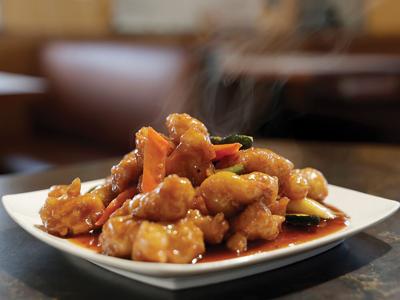

There’s a scene in the 2014 documentary The Search for General Tso in which an aged chef, Peng Chang-kuei, gapes at images of what is perhaps America’s most famous Chinese takeout order, summing up his thoughts in one line: “This is all crazy nonsense.”
Peng had reason to take it as an affront. After all, he is credited with inventing General Tso’s chicken, and the chefs that followed tipped his recipe from savory to sweet. Yet there’s another figure from the past who would quite possibly be more upset.
Glance at the menus of Chinese restaurants in the area and you notice something – someone, rather – is missing.
“No restaurant here has ‘Tso’s,’” observes Wayne Zhu, chef and owner of Juicy Crab, a unique Cajun and Chinese spot in Seaside. “It’s General chicken.”
That appears to be the case, even though most are aware of the association with Tso. When Carmel’s China Delight offered the dish as a chalkboard special one day, it was presented in truncated form.
“I ran out of space on the board,” says China Delight’s Joseph Lee with a laugh. Still, he acknowledges, “Restaurants used to put [Tso’s] on the menu.”
There are suggestions that restaurateurs dropped the name because guests tended to stumble over its pronunciation. Yet Chinese restaurants in less cosmopolitan small towns dotting the Midwest tend to keep Tso in place.
According to Zhu, the difference has much more to do with geography – and a certain American-Chinese creation.
“In the East, it’s General Tso’s chicken,” he says. “In the West, it’s General’s. But it’s the same thing.”
Of course, in this case “same” comes with many caveats. The chicken served by Zhu at Juicy Crab is tossed in a sauce of vinegar, ketchup, soy and oyster sauces, along with water and seasonings. “It’s a little spicy,” the chef points out.
When and why the geographical fallout occurred is not well documented. But those who have searched into the matter indicate that the popularity of Panda Express’ orange chicken is the most likely culprit. At many Chinese restaurants in Monterey County, the sauce used for general’s chicken is similar in fruity tang and sweetness to that of orange chicken or sesame chicken. Somewhere east of the Rockies it begins taking on heat and losing its sugary disposition.
What we call General Tso’s chicken is not an American invention. Chef Peng fled China with the defeat of the Nationalists following World War II and opened a restaurant in Taiwan.
The typical origin story has Peng tagged to oversee the preparation of a banquet honoring a visiting American naval officer, which required a dish more suited to a foreign palate. His resulting creation met with such approval that the officer asked for more information – its name, for example. Put on the spot, Peng responded with General Tso’s chicken, a nod to a famed Qing Dynasty military leader.
Yet that is more likely the start of America’s love for the dish. Research by Jennifer 8. Lee that led to The Search for General Tso suggests that it was part of the Hunanese-inspired menu of Peng’s restaurant in Taipei. And Eileen Yin-Fei Lo, author of The Chinese Kitchen, insists that Peng adopted an existing Hunan recipe of fried chicken pieces covered in a sauce suspiciously similar to his original and its pronounced chile kick.
Peng’s memories lend weight to the recipe’s Chinese heritage. In 2004 he told New York Times Magazine that “Originally the flavors of the dish were typically Hunanese – heavy, sour, hot and salty.”
To give one more twist to its story, Peng eventually moved to New York, only to find that the city had already fallen for another chef’s version of his signature creation.
Chef Tsung Ting Wang also claims the dish, which he served at the restaurant he opened in 1972, a year before Peng arrived in New York. Wise in the ways of American tastes, Tsung had taken the Hunan sting out of the recipe, making the crust thicker and crispier, the sauce thicker and sweeter.
And so we end up with a popular creation, divided and transformed many times over, yet somehow always popular.
As Lee says, “It’s one of my favorites.”
(0) comments
Welcome to the discussion.
Log In
Keep it Clean. Please avoid obscene, vulgar, lewd, racist or sexually-oriented language.
PLEASE TURN OFF YOUR CAPS LOCK.
Don't Threaten. Threats of harming another person will not be tolerated.
Be Truthful. Don't knowingly lie about anyone or anything.
Be Nice. No racism, sexism or any sort of -ism that is degrading to another person.
Be Proactive. Use the 'Report' link on each comment to let us know of abusive posts.
Share with Us. We'd love to hear eyewitness accounts, the history behind an article.